Some novels raise you. This one was raised alongside its readers for a hundred and fifty years. Louisa May Alcott's Little Women — the complete, unabridged novel, both parts, all forty-seven chapters — read the slow way: with a companion written for this book and no other, standing at the end of every chapter, asking you to notice what a fast read misses.
Four Sisters and the Work of Growing Up
Most famous books arrive with a reputation that tells you how to feel about them before you have read a page. Little Women arrives with several, and they contradict each other. It is a children's classic that adults reread in secret and then defend in public. It is a cosy family story set in the shadow of a civil war. It is a book generations of readers have loved for its warmth, and a book its most devoted heroine — inside its own pages — keeps trying to climb out of, toward work, fame and a larger life. All of those reputations are true. Reading it slowly is how you hold them together.
The facts first. Louisa May Alcott published the first part in the autumn of 1868, written in a matter of weeks at her publisher's request for a story for girls — a job she undertook, by her own account, without much enthusiasm and for the money, because money was a permanent emergency in her family. Readers made it a phenomenon anyway, and demanded to know what happened next; she wrote the second part at speed and published it in 1869. The combined book — the forty-seven chapters in this edition — has never been out of print since. Alcott knew the March family from the inside: she was the second of four sisters, raised in Concord, Massachusetts, in gifted, impractical, frequently penniless circumstances, and she put herself, lightly disguised and honestly examined, at the centre of the book as Jo.
You probably know the outline. In a small New England town during the Civil War, with their father away as a chaplain, four sisters — Margaret, called Meg; Josephine, called Jo; Elizabeth, called Beth; and Amy — live with their mother, whom they call Marmee, in a house that comfort has recently left. They are poor, and the book never lets poverty be picturesque: there is work in this house, done by all of them, for wages, for neighbours, for each other. Next door, behind a hedge, is wealth: the old Mr. Laurence's great house, and his grandson Laurie, lonely in it. Across the two parts — with a three-year leap between them, and more years on the far side — the better part of a decade passes. Girls become workers, workers become artists or wives or neither, one thread darkens beyond mending, and the household that begins Part One as a tight winter circle ends Part Two opened out — marriages, departures, returns — into something larger and sadder and, the book insists, not poorer for it.
If that sounds like a plot, it is barely one, and the lack is the design. Alcott built this novel the way families are built: out of episodes, most of them small — a Christmas breakfast given away, a manuscript burned, a fall through ice, a letter home. Almost nothing here is a climax; almost everything is a practice — of generosity, temper, ambition, grief — attempted, failed at, and attempted again with slightly better equipment. The book's frame says so: Alcott opens with the sisters playing at The Pilgrim's Progress, Bunyan's allegory of the soul's journey, and gives each girl a burden to carry. What she does that Bunyan does not is keep the scale domestic. The Celestial City, in this book, looks like a household where people have learned to govern themselves without ceasing to love each other — a smaller prize than heaven, and a harder one to reach.
Why read it slowly? Three reasons.
First, because this is a book about time, and fast reading lies about time. The sisters' changes are deliberately undramatic — a temper mastered by degrees, a vanity starved a meal at a time, a talent tested against the market and found, first, wanting. Read at a gallop, the book can feel static; nothing seems to happen for chapters. Read at walking pace, the same chapters reveal the book's real action running underneath like groundwater: Jo's sentences getting shorter as her self-command grows, Meg pricing a silk dress with her whole future in the scales, Amy's manners travelling further than her ships do. The companion pages in this edition are built to catch exactly those increments, chapter by chapter, because increments are all growing up ever consists of.
Second, because the sisters are best met separately, and haste merges them. A fast reader comes away with a favourite (it is usually Jo) and three supporting figures. A slow reader discovers that Alcott distributed her argument across four girls on purpose: Meg's desire for beauty and ease, Jo's for independence and a name, Beth's for home and quiet, Amy's for polish and a place in the world are four different answers to the same question — what may a girl want, and what will wanting it cost? — and the book refuses to declare a winner. Each sister is the others' road not taken, present at the table. Slow down, and the breakfast-table scenes stop being charming and start being what they are: a parliament of possible lives.
Third, because Alcott's prose rewards the ear. She wrote quickly, and it shows in the best way: dialogue that still sounds spoken, jokes timed like conversation, and a narrator who steps forward like a family friend — amused, partisan, occasionally severe — and then steps back and lets a scene convict or acquit itself. Read the talk aloud when you can. This is a household you are meant to overhear, and overhearing takes exactly as long as it takes.
What to watch for, as you read:
The work. Count it. Who is paid, who is unpaid, who teaches, sews, nurses, governs children, keeps house, writes for the papers — and what each kind of work is said, by the people doing it, to be worth. No English-language novel of its century is more honest about the economics inside a family's affections, or clearer that the March girls' characters are formed less by what happens to them than by what they are required, daily, to do.
The burdens. Each sister carries one named flaw the book treats as her pilgrim's pack: Meg her vanity and discontent, Jo her temper, Beth her shyness, Amy her selfishness and affectation. Watch how unevenly the work of improvement goes. One burden is genuinely laid down. One is carried better each year without ever vanishing. One the book treats not as a sin to cure but as a self to protect. Alcott's moral arithmetic is more grown-up than her reputation suggests.
The letters, manuscripts and performances. This family processes its life in writing: plays in the garret, a family newspaper, letters from camp and Europe, stories sold and stories burned. When something matters most here, somebody writes it down. The companion will keep pointing at the paper trail; it is the novel's nervous system.
The house next door. The Laurence establishment — old gentleman, grandson, tutor, wealth — is the Marches' mirror: everything they lack, arranged around an equal and opposite loneliness. Nearly every crossing of the hedge moves both households. Watch the crossings.
And a word about this edition. Alcott's text is printed complete and unabridged, both parts; everything of ours stands around it, never inside it. The introduction you are reading, the forty-seven chapter companions, the character map, the closing essay and the reading-circle guide are Pagelyra's own work, written for this book and no other. The companions give away nothing beyond each chapter's opening; the closing materials, set after the final chapter, are free to speak of the whole — including the chapter readers have argued about, wept over and written letters about for a hundred and fifty years. We have not protected you from it in the closing pages, and we have been careful not to rush you toward it in the companions. It will arrive at its own pace. So will everything else in this big, patient, funny, unsentimental book — which is, in the end, the best reason to read it at the pace it asks for: the pace of a family, growing up in real time, one ordinary and unrepeatable day at a time.
— The Pagelyra Editors
Every chapter of the edition carries a companion in this form: a spoiler-light orientation, two reflection prompts, a slow-down pointer and a one-line ledger, with ruled space for your own note.
Chapter 1 — Playing Pilgrims
Orientation
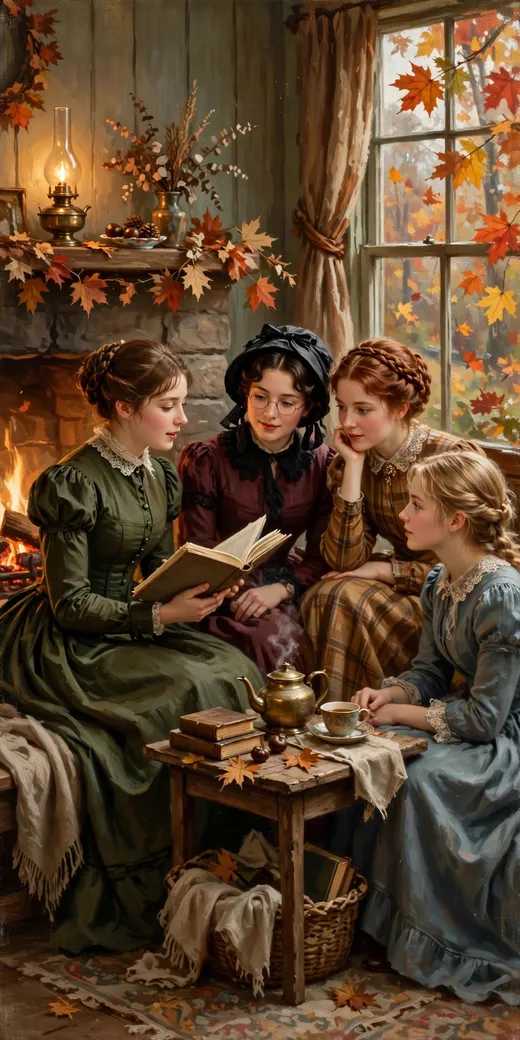
Christmas is coming to a house that cannot afford it. The chapter opens on the four sisters around the fire, each answering the same shortage in a different voice — one grumbling, one sighing over a dress, one aggrieved, one contented — while their father is far away with the army and their mother's letter is about to be read aloud. Notice how much Alcott establishes without a paragraph of description: poverty, war, temperament and love, all carried in talk.
Reflect
- ✎ Each sister's first complaint is a self-portrait. Which complaint in the room is closest to your own reflex under shortage — grievance, embarrassment, envy, or cheerfulness as a discipline? What does the chapter suggest each reflex costs the household?
- The girls end the evening playing at pilgrims, turning an old childhood game of burdens and journeys into a serious resolution. When does make-believe become a plan? What has play ever rehearsed you for?
Slow down here
The reading of the father's letter — the room quieting, the complaints going out like lamps, and four different girls deciding, in four different ways, to be worthy of the man who wrote it. Read the turn of the room slowly; the whole novel is in it.
Ledger
Christmas without presents, Father at the war; four burdens named, and the game made earnest.