Original Books
The Saltmarsh Inheritance — A Cozy Mystery
Our first cozy: a contested will, a vanished brass tide-key, and a lighthouse keeper's secret. Chapter One free.
An original cozy mystery novella by A. R. Calloway — nobody dies. Fenn's Fair has pitched on Stoke Verney Green for a hundred years, and its heart is Sovereign, a gilded galloper horse carved in 1926. But the horse on the ride is a stranger: a brilliant forgery, swapped in the great June storm. Only Poppy Hale, the fairground artist who restored the real Sovereign, can prove it — and find her before Sunday's pull-out.
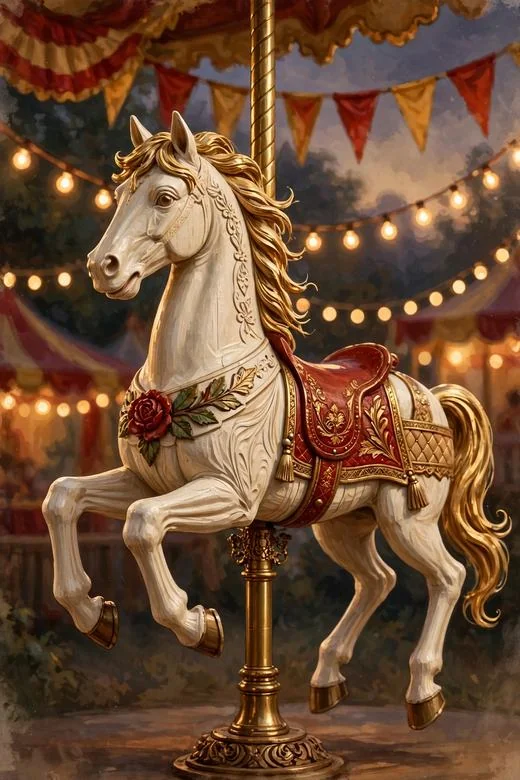
On build day, Poppy puts her hand on Sovereign's ear and finds the famous chip — the one she's filled and blended for fifteen years — simply gone. The wormholes are gone. The gilding is brass pretending to be gold. And her own restorer's mark, hidden under the saddle, isn't there at all. Somebody has had the fair's treasure copied by a professional, swapped the horses in the storm, and hidden the real Sovereign somewhere close — to be driven away with the fair's own loads on Sunday night. The fair opens Saturday, in its centenary year, with the council's lease decision hanging on it. Poppy has four days, a notebook, and a copyist who made one mistake: they painted the horse from a photograph. And the photograph was backwards.
This is a cozy mystery with the corpse left out — deliberately, and proudly. The crime is a theft and a forgery. The stakes are a hundred-year-old horse, a family's livelihood, and a lease the whole village is watching. There is peril, misdirection and a fair amount of strong language in a tea tent — but nobody dies, nobody is killed, and there is no gore, in this book, at all. If you come to cozies for the puzzle and the people, this one was written for you.
Every clue the solution depends on is on the page before the reveal — seventeen of them, from the weight of a horse going up on its pole to a key that was never signed back in. The confession adds colour, not new facts. If you reach the answer before Poppy does, you earned it honestly.
Taken for a Ride is our second cozy, and it keeps the promise of the first in a different key. The Saltmarsh Inheritance turns on a contested will, a vanished tide-key and a keeper's secret in the coastal town of Ternmouth. This one has no death at all — not even offstage, not even in the backstory — just a stolen horse, a forged one, and the woman who paints them both. New town, new fair, new sleuth: read either first; they share fair play and warm communities, and nothing else.
Seventeen clues hold this swap together — the too-light horse, the missing restorer's mark, the rose carved on the wrong shoulder — and every one is on the page before it pays off. If you read cozies the way Poppy paints, noticing everything, our Cozy Mystery Clue & Suspect Log was made for you: a suspect board, a clue ledger and a verdict sealed before the reveal, graded against the book — and against yourself. Open a case file on this book and check our seventeen with your own ledger.
Really. Nobody dies, nobody is killed, and there is no body, no gore and no violence beyond strong words in a tea tent. The crime is a theft and a forgery: the fair's hundred-year-old galloper horse has been swapped for a copy, and the puzzle is proving it and finding her. If you love the puzzle and the people of a cozy but could do without the corpse, this one was written for you.
It's a complete, self-contained novella of about 9,650 words in seven chapters — a full mystery with a beginning, a fair-play investigation and a closed ending, designed for one sitting. It is not a serial instalment and it does not end on a cliffhanger.
No. Taken for a Ride has a new town (Stoke Verney), a new fair, a new sleuth (fairground artist Poppy Hale) and a new puzzle, and stands entirely on its own. The two novellas share only a promise: fair play, warm communities, and clues you can check for yourself.
Yes — that's the house rule. Every clue the solution depends on is on the page before the reveal: the weight, the paint, the gilding, a photograph that lies, a key that never came back. If you spot the copyist's one big mistake before Chapter Four, you have beaten the sleuth to it and the book salutes you.
Pagelyra sells through Gumroad: tap Buy on this page, pay securely on Gumroad, and the download is ready straight after payment — no fake countdowns, no pre-order charges. Chapter One is free to read right now as the sample, so you can meet Poppy and Sovereign before you spend anything. The novella is delivered as a digital ebook (EPUB + PDF), readable on any e-reader, tablet or phone.
Paid checkout is open. Pagelyra sells through Gumroad — pay securely on Gumroad and your files are ready to download straight after payment.
Buy now — instant downloadEvery product still has a free sample in the Free Library — try before you pay. Digital downloads are covered by our Refund Policy.
$6 launch price
EPUB + PDF · 7 chapters · 9,654 words · Personal Use license (licensing details)
Fenn's Fair came into Stoke Verney the way it had come for a hundred years: at dusk, in convoy, with the lorries' headlights sweeping the Green and the whole village out on doorsteps pretending they had just happened to be passing. Children ran alongside the slow wheels. Old Mr. Povey, who had ridden the gallopers as a boy and said so every June, took his cap off to the lead lorry as it passed, the way you would to a hearse or a bride.
Poppy Hale walked beside the third lorry with a mug of tea going cold in her hand and watched the Green take the fair the way it always did — as if the grass had been keeping the shapes of the rides folded away all year and only had to be shaken out. There was the flat rectangle where the waltzer lived. There was the long pale scar of the gallopers' pitch, worn by forty years of the same feet in the same places. Poppy's own van — a retired ambulance the colour of weak custard, with PAINTS, GILDING, REPAIRS in her best gold shading along the side — would go behind the living wagons, where it had gone since she was nineteen and newly apprenticed to the fair's old artist, and in love with all of it beyond reason.
She was thirty-four now, and the fair's artist in her own right, and the love had not worn off. It had only got more specific.
The village had dressed for the centenary the way villages dress for weddings — thoroughly, and with committee supervision. There was bunting on the Green in the fair's own colours, scarlet and gold, strung by the parish council; there was a banner across the church hall reading ONE HUNDRED YEARS OF FENN'S in letters a foot high; and there was, in the window of the Spotted Dog, a framed cutting from the county paper about the fair's first visit in 1926, when Tomas Fenn had driven his horses onto this same grass behind a steam engine and the vicar of the day had preached, that Sunday, on the text the merriment of fools. The present vicar, who rode the waltzer standing up and was not a fool, had put the cutting in the window himself.
"Poppy!" Jacko Fenn came backwards out of the lead lorry's cab with a clipboard in his teeth and the particular grin of a man whose whole year has come right. He was forty-seven, broad, weather-beaten, third generation — fourth if you counted his great-grandfather Tomas, who had carved the first ride this fair ever owned. "We're square with the council, square with the weather, and if the forecast holds we're square with God. Centenary year, Poppy. A hundred years on this Green. I want her looking like the Queen's own."
"Her" was not a woman. "Her" was never a woman, at Fenn's.
On the second lorry, under canvas, lay the gallopers in pieces — the centre engine, the sweeps, the rounding boards with their painted Venetian ladies, and the horses, each wrapped in its own horse blanket. Poppy supervised the laying-out the way she always did, with her whole attention, because a galloper horse dropped two feet onto grass is a winter's worth of repair. Denzil Cole, the fair's mechanic, took the other end of each horse with her. Denzil was twenty-eight, silent by default, and stronger than he looked. One by one they walked the horses down the ramp and laid them in their straw rows on the pitch, under canvas, ready for the morning's build — Sovereign at the head of the row, in her own green blanket with the rose in the corner, where Poppy set her down herself and patted the blanket once, out of a habit older than some of the crew.
Sovereign was the lead horse and the fair's heart, and had been since 1926, when Tomas Fenn carved her out of a single baulk of pine at a workbench in a barn not half a mile from where Poppy stood. She was a grey — cream-white, with a gilded mane and tail, a crimson saddle with gold tooling, and a rose carved in high relief on her shoulder, painted scarlet. Every child in Stoke Verney had a grandmother who had ridden her. Her photograph, taken in 1962 in black and white, hung in the Spotted Dog. Maisie Fenn, Jacko's grandmother, eighty-six and still keeping the fair's books in a hand like copperplate, opened the canvas flap and looked in at the wrapped shape in the straw, and said what she said every year.
"Hello, madam."
The storm came in the night — the worst June storm in years, the radio said, though the fair had sat out worse — and flattened two tents and turned the back field to soup, and by Wednesday's small hours it had blown itself away to France. They built the gallopers in the rain's leftovers. Poppy's job on build day was the rounding boards and the horses — checking every pole, every crank, every stirrup strap before a horse went up on the hoist. When Sovereign's turn came, Denzil took her weight on the chain while Poppy guided her onto her pole, and Denzil shifted his grip and said, surprised, "Goes up easy, this one."
"She's pine," Poppy said automatically. "Pine's light."
"Not like this she isn't."
But the next horse was waiting and the crew were shouting for the chain, and she stored the remark the way you store a tool you're not using yet — without deciding to. The platform turned slowly on its first test, the engine coughing and then settling, and the horses rose and fell in their stately circle, empty, to an audience of ducks.
Poppy stood on the platform with her hands on her hips and watched Sovereign go round, and felt it before she could name it: a draught of wrongness, like a draught in a house.
It was partly the smell. Under the familiar build-day smells — diesel, cut grass, the hot iron smell of the engine — there was a breath of turpentine and new paint, sharp and recent. Rides were repainted in the winter quarters, in January, in a shed that aired for weeks. Nothing on this ride should smell of new paint in June.
It was partly — and she almost laughed at herself for it — the height. Sovereign rode high. A galloper horse's pole runs through the body and into the platform socket, and each horse sits at its own settled depth, known to everyone who builds the ride the way you know your own stairs in the dark. Sovereign sat perhaps an inch higher than Sovereign sat. As if her legs were shorter. As if she were a slightly smaller horse standing on tiptoe.
"You're riding high, madam," Maisie said from the pay box, where she was watching with her glasses on a ribbon. "Centenary airs."
Poppy laughed, because Maisie had said it first and it sounded like nothing, like a thing you say. She walked once around the platform when the test ended and the horses settled, and she looked at Sovereign properly for the first time since the lorry.
The rose on the shoulder was scarlet and perfect. The gilding on the mane caught the thin sun. The crimson saddle was tooled and shining and entirely free of the season's first scuffs, which was wrong too — the saddle always took a scuff coming off the lorry; Poppy touched it up every build day, and had done for fifteen years, and had not done today because there was nothing to touch.
Her hand went, by fifteen years' habit, to Sovereign's right ear, where the tip had been chipped in 1974 — dropped off a tail-lift at a seaside pitch, a clean white nick in the paint that Poppy filled and blended every few winters, so familiar under her thumb that she could have found it blindfold on any horse in England.
The ear was smooth. The ear was whole. The ear was perfect, and unmarked, and had never in its life been dropped off anything.
Poppy stood on the quiet platform with her hand on a stranger's ear and understood, all at once and completely, like a floor giving way: whatever this was, it was wearing Sovereign's colours. But it was not Sovereign.
— End of Chapter One. Chapters Two to Seven arrive with the launch edition. —
Our first cozy: a contested will, a vanished brass tide-key, and a lighthouse keeper's secret. Chapter One free.
Five companion stories from Brindlewick — roses in February, a ferryman's seven minutes, and the keeper who came before. Opening free.
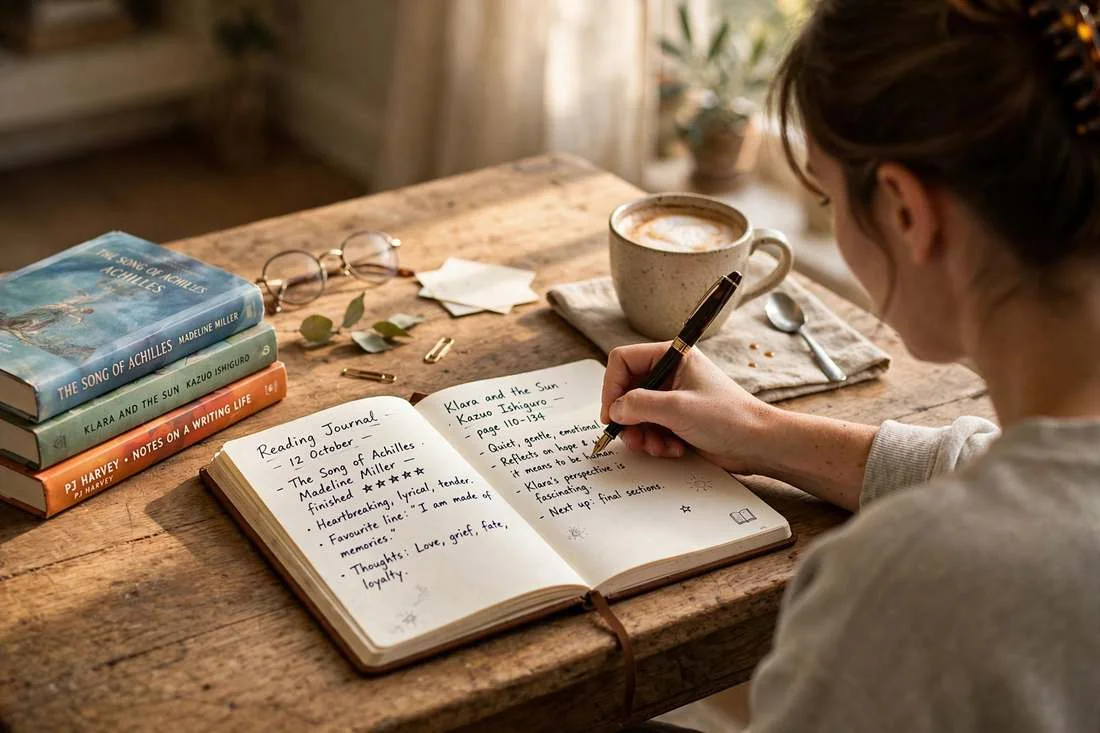 The 2027 Reading Journal
The only dated 2027 reading system in the catalog: three ramp-up months in 2026, twelve dated monthly spreads with a reflection for every month, and the 52-week challenge — a whole year of reading, kept.
$7 launch price
View product The Bookish Advent Countdown
24 nights of stories before Christmas: one original card a night — a read-aloud prompt, a small activity and a question to talk about — plus a parent guide, a 24-night tracker, age-banded book lists and a Christmas Eve keepsake.
$9 launch price
View product The Bookish Gift Planner
Give every reader on your list the right book: match each person to one of ten reader types — 40 gift ideas — then set a budget that holds, list, track buying, making and wrapping, and write the note. A December gifting calendar, one task a day, 1–31 December.
$7 launch price
View product