Reading Journals
Read It Again — The Reread Journal
The journal this edition points to: first-read memory snapshots, then-vs-now spreads, missed-clue logs — built for the second (and twentieth) reading of a book like Anne. Free 3-page sample.
Some novels you read. This one you move into. L. M. Montgomery's Anne of Green Gables — the complete, unabridged 1908 novel, all thirty-eight chapters — read the slow way: with an original Pagelyra companion written for this book and no other, standing at the end of every chapter, asking you to notice what a fast read misses.
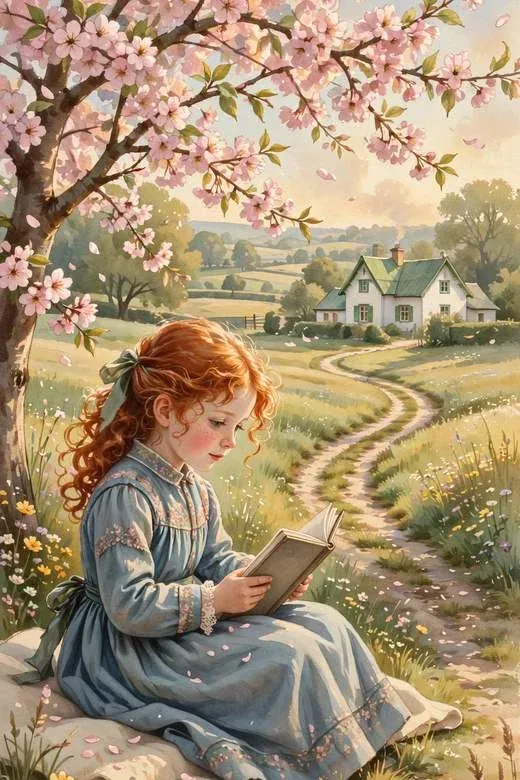
Inside the edition: Montgomery's full text, exactly as published in 1908; a new Pagelyra introduction on why this gentle, funny, quietly radical novel rewards slowness; a companion for every chapter — a spoiler-light orientation, two reflection prompts written for that chapter alone, a "slow down here" pointer to the passage that deserves your whole attention, and a one-line ledger for your own record; and, after the final chapter, a character map, a themes essay, a four-session reading-circle guide for book clubs, and a read-next page for keeping the habit.
No summaries instead of the book. No study-guide homework voice. Just the whole of Avonlea, and good company for the walk through it — chapter by chapter, season by season, at the speed the book was written to be lived at.
The companion stands around the text, never inside it. The introduction waits at the front; each chapter's companion is printed after that chapter ends — orientation first, then the prompts, the slow-down pointer and the ledger line. Every orientation is written from its chapter's opening only, so nothing ahead of you is ever given away. Only the closing materials, printed after the final chapter and labelled as whole-book, speak of the ending.
Montgomery's text is free to anyone — it has been in the public domain for years, and free bare-text copies exist. This page will not pretend otherwise. What the $9.99 pays for is Pagelyra's work: the editing, the original companion written for this book alone, the careful typesetting of a long text with room for your notes, and the curation. Readers who only want the bare text are told, in the FAQ below, exactly where to get it free — which is the honest way to sell an edition of a public classic.
The read-next page of this edition says it plainly: Anne is the book our Read It Again — The Reread Journal was built for. Montgomery's early chapters are full of sentences that mean more once you know the last ones, so your first Anne and your second Anne are genuinely different reads — and the Reread Journal seats both side by side, first-read memory on one page, the reread on the facing one, neither allowed to overwrite the other. Read this edition slowly the first time; journal the return trip in Read It Again.
This edition pairs one classic with a companion we wrote for it. For every other classic — including the ones no edition will ever accompany — there is The Classics Companion Journal: your own blank apparatus of dossiers, context pages, cast trackers, progress ledgers and language notes, reusable for every classic you take on for the rest of your reading life. The two share no pages, and classics readers tend to end up with both — an edition for the book that deserves company, this journal for all the rest.
Yes, and we say so plainly: Montgomery's 1908 text is in the public domain, and free bare-text copies exist. What you pay for here is everything Pagelyra added: an original introduction, a companion for every one of the 38 chapters, the character map, themes essay and reading-circle guide, in a typeset edition with room for your own notes.
Completely. All thirty-eight chapters of the 1908 text, uncut and unmodernised. Our companion never interrupts it: the introduction stands at the front, each chapter companion is printed after its chapter ends, and the closing materials follow the final page. What Montgomery published in 1908 is what you read here, word for word.
No. Each chapter companion is written from that chapter's opening only — it tells you what to notice, never what happens next — and the reflection prompts are about the chapter you have just read. Only the closing section, printed after the last chapter, discusses the whole book, and it is labelled as doing so.
It was designed for you. The companion assumes a reader meeting the book again — or meeting it properly for the first time — and keeps pointing at what children skim and adults feel: Marilla's silences, Matthew's heart, the village learning to love its outsider. The reading-circle session is built for readers who 'already know it' discovering they didn't.
Pagelyra sells through Gumroad: tap Buy on this page, pay securely on Gumroad, and the download is ready after payment. The introduction and the Chapter 1 companion are free as the sample. The edition arrives as an ebook (EPUB + PDF) of roughly 420 pages — the novel plus the companion — readable on any e-reader, tablet or phone.
Paid checkout is open. Pagelyra sells through Gumroad — pay securely on Gumroad and your files are ready to download straight after payment.
Buy now — instant downloadEvery product still has a free sample in the Free Library — try before you pay. Digital downloads are covered by our Refund Policy.
$9.99 launch price
EPUB + PDF · ~420 pages · the complete 1908 novel + the original Pagelyra companion · Personal Use license (licensing details)
Some novels you read. This one you move into.
Anne of Green Gables has been in print without a break since 1908, and the reason is not nostalgia, though it wears nostalgia beautifully. It is that Lucy Maud Montgomery built, inside a small farming village on Prince Edward Island, one of the most complete accounts in fiction of how a person becomes at home — in a place, in a family, and in her own skin. That is a slow process in life. This edition exists because it deserves to be a slow process on the page, too.
You probably know the outline, even if you have never read a word. An elderly brother and sister, Matthew and Marilla Cuthbert of Green Gables farm in the village of Avonlea, send to a Nova Scotia orphanage for a boy to help with the farm work. By a mix-up, the child waiting at Bright River station is a girl: Anne Shirley, eleven years old, red-haired, freckled, talkative past all endurance, and possessed of an imagination so large it has to rename everything it touches in self-defence. The Cuthberts did not order her. She arrives anyway. The whole novel is what happens next — not a single great adventure, but five years of small ones: school terms and Sunday school, friendships sworn and nearly broken, cakes that go wrong, hair that goes wronger, ambitions that grow taller than the girl who holds them.
If that sounds gentle, it is — but do not mistake gentle for slight. Montgomery was a disciplined professional writing at the height of her powers, and she does difficult things as if they were easy. Watch, as you read slowly, how often the comedy and the ache arrive in the same sentence. Watch how a whole village is characterised not by description but by what its people say at kitchen tables. Watch how the Island's seasons are not scenery but structure: the book breathes in springs and school Septembers and winters by the stove, and Anne grows the way a garden grows — in spurts, in setbacks, and mostly when no one is measuring.
Why read it slowly? Three reasons.
First, because this is an episodic novel, and episodes are where its wealth is stored. Anne's scrapes — the ones everyone remembers — are only half the story; the other half is in the quiet chapters in between, where nothing explodes and everything changes. A fast reader collects incidents. A slow reader collects shifts: the first time Marilla softens mid-sentence, the first time Anne chooses a shorter word, the first time the house sounds different. The companion pages in this edition are built to catch exactly those shifts, chapter by chapter.
Second, because Montgomery writes some of the finest talk in English-language fiction, and talk is ruined by hurry. Anne's torrential speeches, Marilla's dry one-line deflations, Matthew's long silences that somehow say the most — these are performances, and they reward being heard at speaking pace. When a scene delights you, the slow-down pointers in this companion will sometimes simply say: read this one aloud.
Third, because this is a book about attention. Anne Shirley's genius — and it is a genius, for all that Avonlea initially files it under "silliness" — is that she attends to the world completely. A lane is not a lane; it is the White Way of Delight. A pond is the Lake of Shining Waters. This is usually described as her "imagination," and so it is, but it is imagination in its most practical form: the refusal to let the familiar go unnoticed. Reading this novel slowly, with a companion that keeps asking you to notice what Anne notices, is a kind of training in her discipline. Most readers finish the book a little more awake than they started it. That is not an accident. It is the design.
What to watch for, then, as you read:
The names. Anne renames everything she loves — places, trees, a geranium, herself ("Cordelia" is her standing ambition; "Anne spelled with an e" is her non-negotiable). Track the naming. A name, in this book, is a claim of belonging, and the map of Anne's names is the map of her home being built. Notice, too, the one place she never renames: Green Gables already has its name, and it is allowed to keep it.
The two educations. Officially, this is the story of Marilla educating Anne — bringing her up, as the chapter title has it. Unofficially, and with far more resistance, it is the story of Anne educating Marilla and Matthew: in tenderness, in pride spoken aloud, in the idea that a household can be run on something warmer than duty. Every chapter moves both lessons at once. The companion will keep asking you which direction the teaching ran this time.
The community. Avonlea watches everything, judges most things, and — eventually, on its own terms and timetable — forgives almost anything. Mrs. Rachel Lynde, who opens the novel at her window, is Avonlea's eyes and voice; the book is honest about the cost of living under that gaze and equally honest about its comforts. Anne is an outsider becoming an insider in a village that does not make either process easy. If you have ever been the new person anywhere, you will recognise every step.
The seasons. Montgomery was an Islander writing about the Island, and the natural world in this novel is observed, not decorative — the Mayflowers and apple blossom, the first snow, the harbour ice. The story's five years are measured in these returns. Read with one eye on the calendar of the natural year and you will find the book's emotional weather is almost always forecast in its literal weather.
One more thing to watch for: Anne's own reading. She is the most book-drunk heroine of her era — she weeps over novels, recites poetry at cliffs and concerts, writes stories of operatic doom in a club of four, and builds half her inner life out of printed matter. The novel never mocks her for it, and neither should we. It simply shows us, chapter by chapter, what a steady diet of stories does to a mind that was starved of everything else first: it gives her vocabulary for her feelings, standards for her conduct, and — when the real tests arrive — scripts of endurance to reach for. If you have ever been told you read too much, this book is your defence, bound in cloth.
A word about this edition. The novel is printed complete and unabridged, exactly Montgomery's text; everything of ours stands around it, never inside it. The introduction you are reading, the thirty-eight chapter companions, the character map, the closing essay and the reading-circle guide are Pagelyra's own work, written for this book and no other. The companions avoid plot spoilers beyond each chapter's opening movement, because a slow read deserves its surprises; the closing materials, set after the final chapter, are free to speak of the whole.
One last thing before you begin. This novel famously opens not with Anne but with her neighbour — a middle-aged woman at a window, watching a road, entirely certain she understands her world. Keep her in mind. By the last page, everyone in Avonlea has been a little surprised, including the reader. That is the book's promise and its method: surprise, borne patiently, turning into love.
Take it a chapter at a time. The kettle, like Marilla's, can wait until the chapter ends — but only just.
— The Pagelyra Editors
— End of the introduction. The complete edition — the full novel with a companion for all 38 chapters — is out now — the Buy button on this page takes you to it. —
Every chapter of the edition carries a companion in exactly this form. Here is the first, complete:
Orientation. The novel opens nowhere near its heroine. It opens in a hollow where a brook crosses the road, at the window of Mrs. Rachel Lynde — Avonlea's most vigilant neighbour — who is knitting, watching, and entirely satisfied with her understanding of the world. Then Matthew Cuthbert drives past in his best suit, on a weekday afternoon, and the order of things cracks. Notice how much of Avonlea Montgomery builds from this one vantage point: we learn the village by learning how it watches itself.
Reflect.
Slow down here. The supper-table conversation at Green Gables, where Marilla explains the errand over Rachel's astonishment. Montgomery's dialogue does double duty — comedy on the surface, a whole philosophy of risk and duty underneath. Read Marilla's replies twice; she wastes nothing.
Ledger. Arrived at Avonlea by Rachel's window; the village holds its breath.
The printed edition leaves ruled space after the ledger for your own note on the chapter.
The journal this edition points to: first-read memory snapshots, then-vs-now spreads, missed-clue logs — built for the second (and twentieth) reading of a book like Anne. Free 3-page sample.
Our own original classic-in-the-making: Mira Solace, a garden losing minutes, and a gate that grew overnight. Chapter One free.
 The Bookish Advent Countdown
24 nights of stories before Christmas: one original card a night — a read-aloud prompt, a small activity and a question to talk about — plus a parent guide, a 24-night tracker, age-banded book lists and a Christmas Eve keepsake.
$9 launch price
View product The Bookish Gift Planner
Give every reader on your list the right book: match each person to one of ten reader types — 40 gift ideas — then set a budget that holds, list, track buying, making and wrapping, and write the note. A December gifting calendar, one task a day, 1–31 December.
$7 launch price
View product Starfall Academy — Issue #1
An original comic about four students at a school built inside a fallen star, and the light that wakes up hungry.
$5 launch price
View product