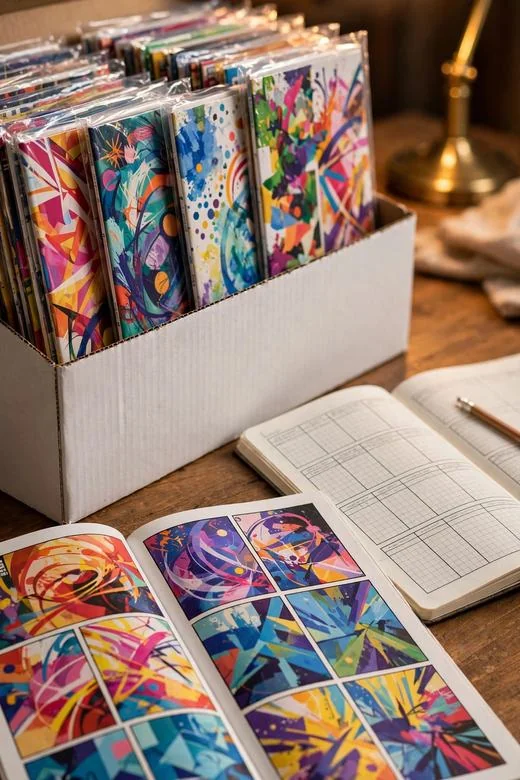
Fantasy got a thousand journals. Science fiction got a bingo card.
Somewhere out there are quest logs, magic-system trackers and map pages for fantasy readers beyond counting. For science fiction — the genre of the Big Idea, of timelines and generation ships and first contact — the entire printable supply is scrapbook ephemera and one small bingo card. As if SF readers tracked their reading the way everyone else does: title, dates, stars, done.
You don't, and you know it. You read with a dial running in the back of your mind — could this actually work? — and half the pleasure is arguing with the physics. What stays with you after the last page isn't a rating; it's a concept you'll chew on at bus stops for a decade, a universe whose rules you could brief a new recruit on, a timeline you had to draw on a napkin to settle an argument with yourself.
The Sci-Fi Reader's Journal is the instrument panel for that reading life. Its engine is a two-page log spread per book: the subgenre charted against sixteen territories, the Big Idea in one line, the tech or concept at the core and what it costs, where the book sits on the Hardness Dial (diamond-hard to gloriously impossible — a description, never a grade), and a Debrief that records the journal's signature judgement, the Plausibility Verdict — holds up, stretched, hand-waved, gloriously impossible — plus whether it mattered, because hand-waved and magnificent is a real and honourable outcome. No star ratings anywhere: the Debrief grades the idea, the world and the people on three separate honest sliders, because a book can be idea-rich and people-thin and that is a finding, not a failure.
Around the spreads, the deep instruments: Timeline Pages you draw yourself, with branch points, loops and a paradox ledger; World & Tech Notes that record a universe's rules the way its engineers would; a Science Audit for the claims you went and checked; a First Contact Log and a Machines & Minds log for the genre's two great Others; Ship's Log series trackers that keep progress and crew — spoiler-safe, plots deliberately excluded; the Subgenre Explorer, a chart of the genre's sixteen territories with your landings marked; Hugo and Nebula Award Missions as decade-gridded long projects; the Idea Shelf, where the concepts that followed you out of their books are kept one line at a time; and Called It, a prediction ledger with check-back years, because science fiction places bets on the future and somebody should keep the receipts. Once a year, the Annual Transmission reads the year back to you — in numbers, and in ideas.
What's inside
- The Sci-Fi Method — the whole system on one page, with the Hardness Dial and the Plausibility Verdict scales
- Mission Control — the dashboard of your SF life: counters, your hardness centre of gravity, plausibility tallies, the current expedition
- The Subgenre Explorer — the genre charted as sixteen territories (space opera, hard SF, first contact, time travel, generation ships, the far shore…), each marked uncharted, landed, explored or home — plus the Explorer's Log of first landings and best finds
- Hugo & Nebula Award Missions — decade-gridded long projects through the genre's public record; the grids print decades, not winner lists, and never imply the award bodies endorse the journal
- Next Expeditions — exactly three live missions, each launched from a gap in your own chart; the deliberate opposite of a TBR pile
- 6 Reading Log spreads — The Book & The Big Idea (the subgenre chart, the Big Idea in one line, the core machinery and what it costs, the Hardness Dial) + The Debrief (the Plausibility Verdict, science-sense notes, the book's wager, and three separate verdict sliders: Idea / World / People)
- Timeline Pages ×2 — drawn timelines with branch points and loops — plus the Paradox Ledger and Time, Ruled field notes
- World & Tech Notes ×2 — a universe's one big rule, its tech and what it costs — plus the Science Audit for the claims you went and checked
- First Contact Log ×2 and Machines & Minds — the genre's two great Others, logged properly
- Ship's Log series trackers ×2 — progress and crew only, spoiler-safe by design; plot memory is deliberately sent to the Catch-Up Journal
- The Idea Shelf ×2 — the concepts that followed you out of their books, one line at a time; the journal's treasure
- Called It ×2 — the prediction ledger: the book's bet, the year to check it, and the verdict when the future reports back
- The Annual Transmission — the year in numbers and in ideas, The Signals honours, and the Five-Year Return
The Sci-Fi Method
1. Open a log spread before the debrief fades. One spread per book, filled in while the book is still warm: the Big Idea in one line, the tech or concept at the core, where the book sits on the Hardness Dial. Ten minutes, tops. A sci-fi reading life is an ideas life — this is where the ideas get written down before they evaporate. 2. Grade the science, not the effort. The Plausibility Verdict is this journal's signature judgement — and it is not a quality score. A book can be hand-waved and magnificent, or airtight and dull. Record what the book did with its science and whether it mattered. Both facts. Never a punishment. 3. Draw the timelines. When a book makes time its puzzle — and the genre's best keep doing it — take it to the Timeline Pages and draw the thing. Branch points, loops, the moment cause and effect shake hands. A drawn timeline settles arguments a paragraph of notes never will. 4. Record the rules and the Other. Worlds get World & Tech Notes: the one big rule of the universe, the tech and what it costs. Aliens, machines and minds get their own logs — because "how this book imagines the Other" is the most revealing page you will ever write about it. 5. Shelve the idea, then survey your territory. Every book that gives you a concept you'll keep goes on the Idea Shelf — one line, dated, so the shelf becomes the map of your intellectual life. Once a year, the Annual Transmission reads the whole year back to you, and the Called It pages start collecting the future's receipts.
The Method is page 3 of the journal itself, and it is printed in full in the free sample. There are deliberately no star ratings in this journal: stars flatten exactly the distinctions science fiction lives on. The Debrief grades the idea, the world and the people on three separate honest sliders instead.
Formats & files
Printable PDF in US Letter and A4, plus a tablet edition for GoodNotes/Notability-style apps — all three in the one purchase. Print at home or at a copy shop; the log spreads, timelines, trackers, Idea Shelf and Called It pages reprint freely under the Personal Use license, so the journal grows with your reading life. Instant download after purchase.
The other genre-native log — and the journals it doesn't duplicate
Pagelyra now makes two genre-native logs, one for each shelf. This one serves the bookshelf; the longbox has Panels & Pages — A Comic & Graphic Novel Reading Log, which logs comics by issue and arc with full creator credits and art notes. They share no pages and neither tries to do the other's job — and yes, the pairing is deliberate: our own comic, Starfall Academy, is a science-fiction story, and its readers tend to live on both shelves.
Two deliberate absences, stated plainly: there are no plot summaries in this journal — rebuilding a series' story is our Series Catch-Up & Recap Journal's whole job, and it does it properly — and there are no monthly logs, star ratings or TBR piles; those live in the flagship Ultimate Reading Journal Bundle. No mood shelves or check-ins either (that's The Mood Reader's Journal). This journal keeps the one record nobody has ever offered a science-fiction reader: not what you read, but what it made you think.
Who this is for
Hard-SF readers who grade the physics as they go — and soft-SF readers who know the dial position is a description, not a grade. First-contact devotees, generation-ship romantics, timeline drawers, award-list completists working a decade at a time. Anyone whose book-club arguments are really about whether the science earned its hand-wave. And if you read no science fiction at all — honestly, this one isn't yours; the bundle is your journal, and we would rather tell you that here than sell you 44 pages you will not use.
Free sample
Three real pages form one complete, genuinely usable system: The Sci-Fi Method (journal p.3 — the whole system on one page, including the Hardness Dial and Plausibility Verdict scales), The Book & The Big Idea (p.11 — the signature log page: subgenre chart, the Big Idea in one line, the core machinery and what it costs), and The Debrief (p.12 — the plausibility verdict, science-sense notes, the book's wager, and the three verdict sliders). Method + one full log spread is enough to log tonight's science-fiction book fully and honestly, for free.
Get the free sample
The Sci-Fi Reader's Journal
$7 launch price
44 pages. License: Personal Use — print/copy for your own reading life, as many times as you need. Sharing the files or reselling is not permitted; see Licensing.
FAQ
Can I buy it today?
Yes — checkout is open now. Pagelyra sells through Gumroad: tap Buy on this page, pay securely on Gumroad, and your files are ready to download straight after payment. The free sample on this page stays free either way, and every purchase is covered by our Refund Policy.
How is this different from the Ultimate Reading Journal Bundle?
The bundle is genre-neutral and journals your first reads of everything — monthly logs, review templates, star ratings, the 52-book challenge, your TBR shelf. This journal contains none of those pages. It is built for one genre's machinery: the Big Idea, the plausibility of the science, drawn timelines, world rules, first contact, an idea shelf and a prediction ledger. A science-fiction book logged in both gets its dates and review in the bundle and its thinking here; the pages, prompts and systems share nothing.
And how is it different from the Series Catch-Up & Recap Journal?
That journal rebuilds plot: what happened in the earlier books of a series, who's who, which threads are open, behind a strict spoiler line, so you can start the next volume. This journal's series pages (the Ship's Log) deliberately record progress and names only — where you are, who you're travelling with, what's next — and send all plot memory to the Catch-Up Journal, where it belongs. They are complements, not rivals: one keeps the story, this one keeps the ideas.
I mostly read fantasy. Is this for me?
Honestly: it's built for science fiction, and its best pages — plausibility verdicts, science audits, timelines, prediction ledgers — assume a genre that argues with physics and bets on the future. If your reading is half SF, the log spreads work for every SF book you touch and the journal earns its shelf space on those alone. If you read no science fiction at all, this one isn't yours — the Ultimate Reading Journal Bundle is, and we'd rather tell you that here.
What if a book's science is just… wrong? Do I have to be a scientist?
No — the Plausibility Verdict has a box for "gloriously impossible" precisely because some of the genre's best books run on beautiful nonsense, and the verdict records what the book did and whether it mattered, never a punishment. And the Science Audit is optional appetite, not homework: it's there for the claims that make you curious enough to check. "Hand-waved, earned it" is a complete and honourable review in this journal.