Original Comics
Starfall Academy — Issue #1: First Light
Our own original comic — the first thing most readers log in Panels & Pages. Four students, a school inside a fallen star, a light waking up. Free reader preview.
44 pages built for the way comics are actually read — per issue and per arc, with the full creative team credited and whole pages for the art. Your reading journal thinks a comic has one author and no pictures worth mentioning. It is wrong on both counts.
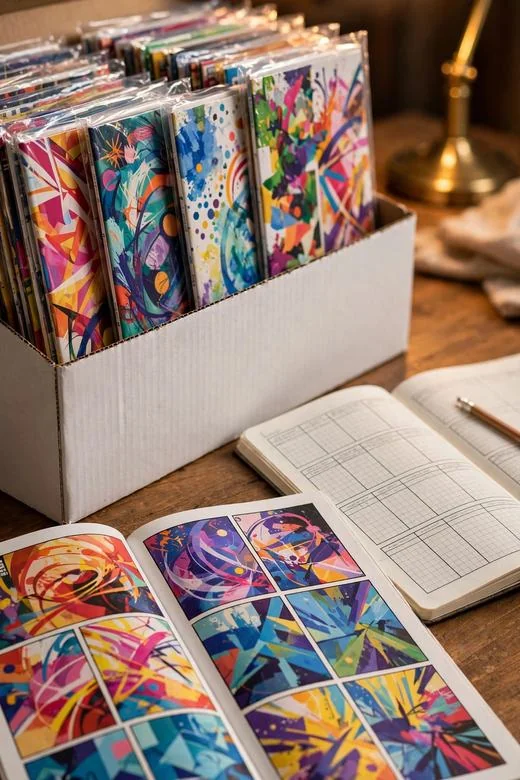
A comic has a credits page — a writer, an artist, a colourist, a letterer — and half of why you loved an issue can live in any one of those names. It arrives in pieces: this month's floppy, the trade you waited six months for, the back issue that finally filled the gap in the run. And unlike a novel, you don't just read it — you open it again afterwards purely to look at it. Every reading journal ever printed assumes the prose shape anyway: one title, one author, a star rating, done. Comics readers have been improvising around that mismatch for years, with spreadsheets and apps and notebooks held together with hope.
Panels & Pages starts from the comic. The Issue Log credits the whole creative team on every page, keeps the story in three panels, and asks the question prose journals can't: cliffhanger or self-contained? When a storyline wraps, the Volume & Arc spread retells it as a six-panel page and tracks its turning points and loose ends. The Art Notes give the visual half of the medium its due — layout studies with sketch boxes for copying page designs in pencil, splash and page-turn records, colour palettes you swatch yourself, and a lettering page for the craft everyone hears and nobody credits. Creator Trackers follow writers, artists, colourists and letterers by name, so your loyalty turns into your reading list. The Series Shelf tracks what you own and how far you've read — never plot homework — beside a pull list, a release watch, and a gaps-in-the-run page for the hunt.
And because comics readers return to pages the way other readers return to whole books, there is a Return Shelf for the issues you reopen just for the art, an annual Panels Review, and a Panels Awards with the categories that actually fit this medium: Best Splash, Best Cliffhanger, Best Lettering Moment, Panel of the Year.
1. Credit the whole team. Every Issue Log starts with the credits page: writer, artist, colourist, letterer, cover artist. Comics are made by teams; log them like it. In a year, these fields quietly become the most valuable pages you own. 2. Log the issue, not just the series. Single issues are the unit comics are published in, so they are the unit this log records: what happened, the panel that got you, whether the ending was a cliffhanger — three minutes, while it's fresh. 3. Close the arc. When a storyline wraps — in issues or in a trade — give it the Volume & Arc spread: the story told in six panels, the turning points, the cliffhanger it left (or didn't). 4. Study the art on purpose. When a layout stuns you, a splash earns its page turn, a palette does the acting, or a sound effect lands like a punch — it goes in Art Notes, with sketch boxes for copying layouts in pencil. Looking closely is a reading skill; this log treats it as one. 5. Follow the creators, keep the shelf honest. Creator Trackers follow the people; the Series Shelf tracks what you own and have read — and only that. This log never asks you to recap plots to yourself; it keeps the record of a reading life in comics: what you read, who made it, and what it looked like.
The Method is page 3 of the log itself, and it is printed in full in the free sample. A log you keep up beats a beautiful log you abandon — one line per field is a complete entry, and the sketch boxes want pencil and thirty seconds, not talent.
Printable PDF in US Letter and A4, plus a tablet edition for GoodNotes/Notability-style apps — all three in the one purchase. Print at home or at a copy shop; the Issue Logs, Arc spreads, Art Notes and study page reprint freely under the Personal Use license, so the log grows with your collection. Instant download after purchase.
Pagelyra publishes an original comic of its own — Starfall Academy Issue #1: First Light ($5) — and this log is its natural shelf-mate: log Issue #1's full credits, mark the panel that got you, and start the Starfall row of your Series Shelf. A $7 log beside a $5 comic is the pairing we built both halves of. The log itself stays product-neutral — no marketing inside its pages, just the cover, the license and the colophon.
There are no prose review templates, monthly logs or star-rating pages in Panels & Pages — those live in our flagship Ultimate Reading Journal Bundle. It shares no pages with the rest of the line either: no memory snapshots or then-vs-now spreads (Read It Again — The Reread Journal is the reread tool — and even here, returning is a viewing log, art only, with no memory tests), no mood shelves or check-ins (The Mood Reader's Journal), no club hosting material (the Silent Book Club Host Kit), and no plot recaps or "previously on" briefings — catching up on story is the Series Catch-Up & Recap Journal's job. This is the log for the shelf the others can't see: the longbox.
This log follows your longbox — the issues you read, alone or with the shop. The chapter-book years at home ask for a different record: one book read aloud, together, a chapter a night. Our Read Together — The Family Read-Aloud Journal follows the family's nightly chapter — session logs, predictions in ink, the voices log, milestones and a letter to be read when they're grown — and it is built for chapter books of every kind, graphic novels very much included: a long graphic novel read aloud together across a week of nights is exactly its home ground. It shares no pages with this log; Panels & Pages keeps your shelf, Read Together keeps the family's evenings.
This log is genre-native to comics — credits, arcs, art. Your prose science fiction deserves the same courtesy from its own side: our Sci-Fi Reader's Journal logs each SF book by its Big Idea, its place on the Hardness Dial and its Plausibility Verdict, with drawn timelines, a first contact log, the Idea Shelf and a prediction ledger — the two genre-native logs of the catalog, one for the longbox and one for the bookshelf, sharing no pages. (And yes, the pairing is deliberate: Pagelyra's own comic is a science-fiction story, and its readers tend to live on both shelves.)
Monthly-issue readers whose pull list deserves a record. Trade-waiters and omnibus collectors. Readers who check the credits page first and follow artists between publishers. Anyone currently tracking a collection in a spreadsheet and quietly hating it. And if you read prose only — honestly, this log is not for you; the bundle is your journal, and we would rather tell you that here than sell you 44 pages you will not use.
Three real pages form a genuinely usable starter system: The Panels Method (log p.3 — the whole system on one page), one complete Issue Log (p.11 — full credits, the story in three panels, the cliffhanger check), and Panel Layouts That Stunned (p.27 — the Art Notes page with sketch boxes). Method + one full issue log + one art study is enough to log a real comic tonight, honestly, for free.
Paid checkout is open. Pagelyra sells through Gumroad — pay securely on Gumroad and your files are ready to download straight after payment.
Buy now — instant downloadEvery product still has a free sample in the Free Library — try before you pay. Digital downloads are covered by our Refund Policy.
$7 launch price
44 pages. License: Personal Use — print/copy for your own reading life, as many times as you need. Sharing the files or reselling is not permitted; see Licensing.
Yes — checkout is open now. Pagelyra sells through Gumroad: tap Buy on this page, pay securely on Gumroad, and your files are ready to download straight after payment. The free sample on this page stays free either way, and every purchase is covered by our Refund Policy.
You can for prose. But a normal journal has one "author" line for a book made by four or five people, no place for arcs, issue numbers, cliffhangers or formats, and nothing at all for the art — no layout studies, no palettes, no lettering. The Bundle journals first reads of books; Panels & Pages shares no pages with it and was built for the longbox, not the bookshelf.
Trades and omnibuses are first-class citizens here (the Arc spread was designed for them, and the Issue Log's format field covers floppy, trade, digital, omnibus and library copies). The log is deliberately not a manga-specific tracker — dedicated manga logs already exist — but nothing in these pages stops a manga reader using them; volumes, chapters and creators log the same way.
It tracks where you stopped and what to read next (the Series Shelf and Release Watch), but it deliberately does not recap plots — no "previously on" briefings or character dossiers. That's a different tool for a different job (our Series Catch-Up & Recap Journal), because a reading log you keep forever shouldn't be full of spoilers for your own shelf.
Ten full Issue Logs and three complete Arc spreads are printed, and those pages (plus the Art Notes and study page) are designed to be reprinted or duplicated without limit — a long run gets as many pages as it needs. You get printable PDFs in US Letter and A4, plus a tablet edition for GoodNotes/Notability-style apps, all in the one purchase.
Panels and Pages is our love letter to the form; the making of our own comic is documented the same way we make everything — in the open. The Creator Interview: Building Pagelyra covers how Starfall Academy was plotted backwards from its final page, palettes, false starts and all.
Our own original comic — the first thing most readers log in Panels & Pages. Four students, a school inside a fallen star, a light waking up. Free reader preview.
The flagship for prose first reads: trackers, monthly logs, review templates and the 52-book challenge planner — the pages this log deliberately leaves to it.
Silent openers, palette rules and cliffhanger maths — then log the layouts yourself in the Art Notes.
 The Horror Book Club Questions Pack
Discussion cards for the books you read with the lights on: 52 printable cards and 256 questions built for horror's own machinery — dread vs gore, haunted houses, folk horror, cosmic horror, monsters and what they mean — plus a host guide with a spoiler charter and the Content & Courage Charter for mixed-courage rooms.
$6 launch price
View product The Romantasy Book Club Questions Pack
Discussion cards for the books where the magic system and the love story are the same plot: 64 printable cards and 304 questions built for romantasy's twin engines — fated mates, morally grey verdicts, spice earned by the plot — plus trope bingo, two scorecards (spice and magic) and a host guide with the Spice & Comfort Charter for mixed-tolerance rooms.
$6 launch price
View product The Mood Reader's Journal
Pick your next book by how you feel: a Mood Library of your own books shelved by the feeling they give, a two-minute nightly check-in, and match spreads that grade the fit — never the book. No TBR list, on purpose.
$7 launch price
View product