Original Books
The Clockwork Garden — A Novella
The companion novella: Mira Solace, a garden losing minutes, and a gate that grew overnight. Chapter One free.
Five original stories from Brindlewick, by A. R. Calloway — companion tales to The Clockwork Garden. The garden that keeps the town's time has kept other hours too: roses it spent in February, seven minutes it borrowed from a ferryman, and the summer it chose its keeper. Five complete stories, one small town, no plot retold.
The Clockwork Garden told one year of Mira Solace's life — the year the garden started losing minutes and grew a gate. These five stories tell the year before it, and one summer sixty years earlier: how the roses came up in February snow, why the station clock owes the ferry seven minutes a night, and what Wren Solace gave up when the garden chose her at twenty-one. Same town, same rules — lost time is spent as out-of-season growth, the keeper covers for the garden, and the garden chooses its keeper — in stories short enough to finish with a single cup of tea, each one complete.
You do not need the novella first, and the novella does not need these. Read in either order: the tales deepen the world of The Clockwork Garden without spoiling its ending, and nothing from the novella is retold here.
Four of the stories belong to the year before the novella opens, and they are arranged as a quiet countdown. "Roses in February" shows the garden spending time it does not have; "The Ferryman's Seven Minutes" shows what the town does when lost time has to be answered for; "What the Garden Gives Back" brings Gran to the gift she has been avoiding for sixty years; and "The Night the Clocks Agreed" closes the year with the garden gathering itself for the keeper to come. The remaining story, "The Keeper Before", steps back sixty years to Wren Solace at twenty-one — a railway ticket, a young man in the city, and one summer to decide whether the garden gets her life. Read in order, the collection explains how Mira inherited not just a garden but a pattern: lost time is spent as out-of-season growth, the keeper covers for the garden, and the garden chooses its keeper.
This collection ships with its club night already written: The Short-Story-Collection Book Club Kit includes a complete ready-made discussion guide to this collection (kit pp.21–27) — how to run the collection, one full discussion page per story with eight grounded questions each, a scorecard prompt and the best debate cards per story, and an across-the-collection finale page. The kit itself (pp.1–20) is genre-free and works on any collection; the Tales guide is its bonus ready-made night, so readers of this collection get its discussion written for them. An honest read-it-then-discuss-it pairing: the collection is $4.99, the kit is $6.
Yes — the opening of Story One, 'Roses in February' (about 775 words), is printed in full below on this page, and as a PDF in the Free Library. No email wall on this page.
No. This is a companion collection set in the same world, in the year before the novella opens — it stands on its own, the novella's plot is not retold, and readers who start here meet Mira and Gran fresh.
EPUB and PDF ebook editions, readable on e-readers, tablets and phones.
10,341 words across five complete stories — most readers finish it in one or two evenings, or one story at a time with morning coffee.
Yes — checkout is open now. Pagelyra sells through Gumroad: tap Buy on this page, pay securely on Gumroad, and your files are ready to download straight after payment. The free sample on this page stays free either way, and every purchase is covered by our Refund Policy.
Paid checkout is open. Pagelyra sells through Gumroad — pay securely on Gumroad and your files are ready to download straight after payment.
Buy now — instant downloadEvery product still has a free sample in the Free Library — try before you pay. Digital downloads are covered by our Refund Policy.
$4.99 launch price
EPUB + PDF · 5 stories · 10,341 words · Personal Use license (licensing details)
The smell reached her on the shop steps, before she had the key in the lock: roses, in February, in the snow.
Mira Solace stood with her hand on the cold iron handle and breathed it in against her better judgement. It was not the ghost of a smell, not a soap or a scented candle or something the wind had carried from the florist's on Bridge Street. It was the real, green, honeyed weight of them — dozens of them — and it was coming over her grandmother's garden wall, through air so cold it hurt her teeth.
She unlocked the shop out of habit. She hung her coat on its peg out of habit. Then she took the long way through the back room, past the clocks ticking their patient parliament, and opened the garden door with the particular dread of a woman who maintains other people's certainties for a living.
The roses had come up in the night.
Not a brave early bud or two. All of them. Every bush along the south wall stood in full, absurd, summer bloom — pink, cream, and the deep red of the old climbers — each flower beaded with meltwater, each stem rising out of six inches of unbroken snow. The snow around the beds had melted in perfect circles, as if every bush sat in its own private June. Steam rose off the petals in the cold. It looked, Mira thought, like the garden had forgotten what month it was, and was too proud to ask.
"Gran," she called, in the voice she used for customers whose clocks had done something impossible. "Gran. Come and look at this, please."
Wren Solace appeared at the kitchen door in her dressing gown, eighty-one years old, with a teapot in one hand and the expression of a woman whose kettle has merely boiled. "Oh," she said. "Oh dear. They've come up early."
"Early." Mira gestured at the snow, the steam, the whole steaming impossibility of it. "Gran, it's February. There was a frost hard enough last night to split the pipe behind the scullery. Roses do not come up early. Roses come up dead."
"These ones come up when they're ready." Her grandmother came down the path in her slippers, quite unconcerned about the snow, and put the back of her hand against a red bloom the way you'd feel a child's forehead. "Feel that."
Mira felt it. The petals were warm. Not sun-warm — there was no sun worth the name — but living-warm, body-warm, as if the flowers were running a slight fever.
"The garden lost some time in the night," Gran said, in the tone of a woman reporting that the post was late. "When it loses time, it has to spend it somewhere. It spent it here."
* * *
Mira was a horologist. She had wound the clocks of Brindlewick for eleven years. She could hear a mainspring failing through a closed door, and she had a craftsman's deep, tidy hatred of explanations that did not explain. Gardens lost time. Time got spent. On roses. She opened her mouth to object to all of it, in order, and found her grandmother watching her with the mild, waiting look she remembered from childhood — the look that had always meant: you may ask, and I will answer, but only the question you actually ask.
So she asked the practical one. She was proud of it, afterwards, the way you are proud of holding onto a railing.
"What do we do with them?"
"We cut them," said Gran promptly. "A hard frost is coming back tonight, and it will take every one of them where they stand. Cut, they'll last a fortnight in water. Left, they'll be black by morning." She went back up the path for the secateurs and the big enamel jug, calling over her shoulder: "And we don't make a song about it, love. Cut them like it's the most ordinary thing in the world."
It took an hour. The snow squeaked under Mira's boots; her fingers went numb and then, working among the warm stems, strangely warm again. The scent was so thick it coated the back of her throat. Gran moved along the bushes with the ease of a woman half her age, choosing, snipping, laying each stem across her arm, and if her hands shook once or twice, the secateurs made it look like nothing.
They filled the enamel jug, and a bucket, and finally the deep kitchen sink.
"There," said Gran, looking at her flooded, flowering kitchen with satisfaction. "Now. Half of those are coming over to your shop."
— End of the free sample. The rest of Story One, plus four more stories, arrives with the launch edition. —
The companion novella: Mira Solace, a garden losing minutes, and a gate that grew overnight. Chapter One free.
Our first mystery: a contested will, a vanished tide-key, and a lighthouse keeper's secret. Chapter One free.
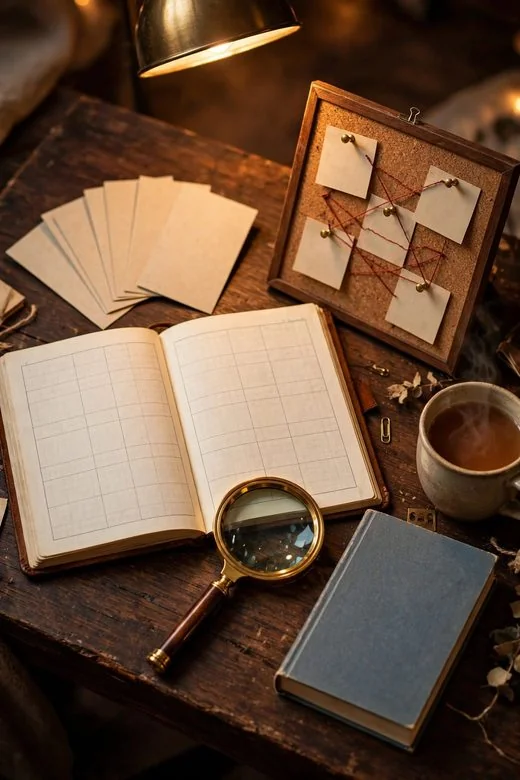 The Cozy Mystery Clue & Suspect Log
The detective's notebook for readers who solve along: a suspect board, a clue ledger, an alibi grid and a motive map per book — and your verdict sealed, dated and scored before the reveal. Works with any cozy; the fields are crime-neutral.
$7 launch price
View product The Sci-Fi Reader's Journal
The first reading journal built around science fiction's own apparatus: per-book log spreads for the Big Idea, the Hardness Dial and the Plausibility Verdict, drawn timelines, world & tech notes, a science audit, first contact and machine-mind logs, sixteen subgenre territories, award missions, the Idea Shelf and the Called It prediction ledger. No star ratings, no plot summaries.
$7 launch price
View product The Poetry Reader's Companion
A printable journal for one poem at a time: read it aloud, copy the line that stopped you by hand, live with it a day, and come back to it for years. Per-poem spreads (The Poem on Arrival + Sitting With It), line-check grids for poems by heart, return entries stacked across the years, poet pages, collection logs and a Commonplace Verses section where the poet is always credited. No poems printed in it — the poems are yours.
$7 launch price
View product