Book Club
The Silent Book Club Host Kit
For the other kind of night: no set book, no cooking, no discussion questions — invitations, signs, a timer system and share prompts for quiet reading together. Shares no pages with this kit.
The book club you can eat. In a cookbook club, the club picks one cookbook, every member cooks a dish from it at home, and the table tastes the whole book in a single night. It's the dinner-party trend of the moment — and nearly every host is running one out of a shared Google Doc for who-cooks-what, a group chat for allergies, and hope as the seating plan. This kit is the whole job, printed: an 8-page host's guide and 28 printables — the dish-claim board that stops courses colliding, allergy flags read aloud before forks, scorecards that judge the book and never the cook.
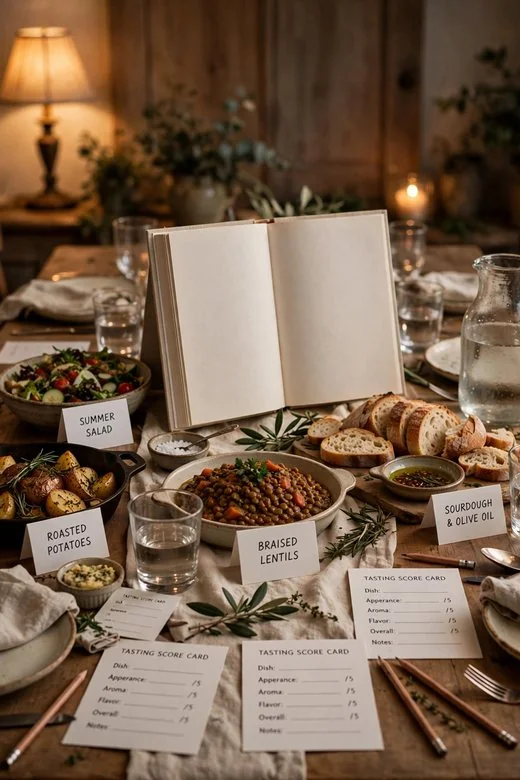
A cookbook club hasn't just talked about the book by the end of the night — it has tested it: every recipe cooked by a different pair of hands, in a different kitchen, with different equipment and different confidence. No single reviewer can do that. Twelve home cooks can. The starters tell you about chapter one, the mains argue the author's whole philosophy, and dessert is the conclusion — and you will have opinions.
What decides whether everyone comes back is not the food; it's the machinery around it. No claim system, so courses collide and six people bring dessert by accident. No flag system, so dietary needs get discovered at the table, fork in the air. No scoring rules, so honest feedback lands on the cook instead of the book. This kit is that machinery, designed once and printed forever: tested criteria for choosing a cookbook that can actually carry a table, a claim board that balances starters, mains, sides, bread, desserts and drinks before anyone buys an ingredient, a meeting-day run sheet with the reheating rota, and the two systems that protect the night — the allergy protocol and scoring without cruelty.
1 · Pick the book (at the previous meeting, or two weeks out) — voted from the Next-Book Ballot, announced with the invitation so everyone can get a copy. 2 · Claim the dishes (the week before) — the board goes out where everyone can see it; cooks claim a course slot and a dish, first claim wins, the host fills the empty course. 3 · Cook at home (meeting day) — every dish in its own kitchen, label tents filled in while the cook still remembers what's in it. 4 · Gather & graze — dishes land, labels go up, the host walks the table reading dish, cook, page and flags; then a little of everything, score cards as you go. 5 · Score & verdict (over the last cups) — dish scores shared kindly, then the club's verdict on the book: worth buying? worth cooking from again? 6 · Vote the next book & close — ballots out, leftovers labelled and distributed like treasure, one line in the Host's Club Log before the host sleeps.
Printable PDF in US Letter and A4, plus a tablet edition of the guide and paperwork for hosts who run the night paperless — all three in the one purchase. Signs, the claim board and checklists print once and live in the host's folder; tents, score cards, labels and ballots reprint per meeting. Instant download after purchase.
There are no recipes in this kit — and no text from any real cookbook. That is deliberate, and it is the point. The recipes live in whichever cookbook your club chooses; this kit is the machinery that turns a pile of cookbooks into a club: the choosing, the claiming, the flags, the scoring and the verdict. We would never reprint another author's recipes, and the kit never asks you to — a dish only needs its own page, cooked by its own cook.
Our Silent Book Club Host Kit runs the opposite kind of night: no shared book at all, no discussion, everyone reading their own book quietly together, with a timer system and share prompts instead of questions. This kit is a talking, eating club built entirely around one shared book — cooked by everyone and judged together. The two kits share no pages: not the quick-start, not the signs, not a single card. If your club reads in companionable silence, the Silent Kit is your tool; if your club cooks its book, this one is. Hosts who run both kinds of night use both.
Our flagship Ultimate Reading Journal Bundle includes book-club sheets for a traditional talking club: genre-free discussion frameworks and a simple next-book vote that work for any novel. This kit shares none of that — it runs a club whose book is cooked, not just discussed, and its ballot is built for cookbooks specifically: the cuisine you'd love next, the difficulty ceiling this month, and one honourable veto. Different night, different paper; clubs that do both keep both.
A cookbook club night is one evening around one table. The trip version — a whole weekend where the itinerary is reading, in a house you booked yourselves — has its own Pagelyra kit: The Reading Retreat Kit. It plans the retreat itself: dates, a 12-question venue checklist, a budget worksheet, rooms, both reading modes, meal plans that respect the reading blocks, reading passports, fireside prompt cards and the closing ritual. The two kits share no pages; a club that cooks its book monthly and escapes yearly will use both, the way it uses both a meeting and a holiday.
Cookbook-club hosts currently coordinating the whole night in a shared document. Book clubs ready to eat their reading. Dinner-party people who want a reason that recurs monthly. Mixed-confidence tables — the criteria demand un-losable dishes, and a member who can't cook a round claims a service role (drinks, the bakery run, hosting, washing-up captain) that counts on the board, in writing. If your club would rather read quietly side by side, this is honestly not your kit — the Silent Book Club Host Kit above is.
Three real pages from the kit are free: the Host's Quick-Start Guide (kit p.3 — the whole club flow plus the word-for-word welcome script), the Dish-Claim Board (p.13 — the kit's signature page) and the Dish Label Tents (p.19 — dish, cook, page and allergen flags in front of every dish). Together they are a genuinely usable starter kit: quick-start + claim board + label tents are enough to host a simple first cookbook-club night tonight. Unabridged, not a watermarked teaser.
Paid checkout is open. Pagelyra sells through Gumroad — pay securely on Gumroad and your files are ready to download straight after payment.
Buy now — instant downloadEvery product still has a free sample in the Free Library — try before you pay. Digital downloads are covered by our Refund Policy.
$9 launch price
36 pages: 8-page host's guide + 28 printables. License: Personal Use — for this kit, that expressly covers an organiser printing the sheets and cards for their own club's meetings. Sharing the files or reselling is not permitted; see Licensing.
Yes — checkout is open now. Pagelyra sells through Gumroad: tap Buy on this page, pay securely on Gumroad, and your files are ready to download straight after payment. The free sample on this page stays free either way, and every purchase is covered by our Refund Policy.
No — deliberately. A cookbook club means cooking from one real cookbook your club chooses, and this kit is the machinery around that meal: choosing the book, claiming dishes, flagging allergies, scoring kindly, and delivering a verdict on the book. We would never reprint another author's recipes; the kit makes whichever book you pick work as a club book.
That kit runs a silent club: no shared book, no discussion, everyone reading their own book quietly together. This kit is its opposite in every way that matters — one shared book (a cookbook), cooked by everyone, talked about loudly over the food. They share no pages; hosts who run both kinds of night use both.
Yes. The claim board scales down (six cooks claim six slots; the course list shows the shape, not a quota), and the kit is built for mixed confidence: the book-choosing criteria require a skill spread with genuinely un-losable dishes, and members who can't cook a round can claim a service role — drinks, the bakery run, hosting, washing-up captain — which counts as a claim, on the board, in writing.
Per meeting (for about 12 cooks) you'll typically print 2–3 sheets of dish label tents, 4 of score cards, 1 of leftover labels, and a ballot sheet on voting months — the kit's Printing Notes page lists it exactly. The claim board, signs, verdict page and checklists print once and live in the host's folder. US Letter and A4 editions are both included, plus a tablet edition of the guide and paperwork if you host paperless.
The sister format to this kit swaps the tasting table for the reading chair: one shared collection, a story a week, five endings to argue about. Our Short Story Collection Book Club Kit runs that night — collection-shaped questions, a story ballot and a spoiler charter written for books with more than one ending.
Cookbook-club members cook the book before they judge it — usually with a novel playing. The listening life has its own record: The Audiobook Companion Journal, with narrator-first listening logs, two verdicts per book (Story and Voice) and a guilt-free fell-asleep recovery page for the chapter the sauce demanded.
For the other kind of night: no set book, no cooking, no discussion questions — invitations, signs, a timer system and share prompts for quiet reading together. Shares no pages with this kit.
The flagship 86-page printable — including the genre-free book-club sheets (any novel, discussion frameworks, a simple vote) this kit deliberately goes past for cook-the-book nights.
For talking clubs whose shared book has a map in the front: 64 printable cards and 304 questions on magic systems, maps, prophecies and the villain's case.
 The Historical Fiction Book Club Questions Pack
Discussion cards for the novels built from the record: 64 printable cards and 304 questions built for historical fiction's own mechanics — the fact–fiction line, real people as characters, period detail, research rabbit holes and endings history already spoiled — plus a host guide with a spoiler charter, the Record Charter and a scorecard that grades fact–fiction balance. One pack works with any historical novel your club picks — no per-title kit to buy again each month.
$6 launch price
View product The Home Library Journal
A paper catalog for the books you own: an eleven-field catalogue entry for every copy, a shelf code for every shelf (LIV-02-B), drawn shelf maps, a loans ledger with due-back dates, a ranked wishlist checked against what is already owned, a weeding and release record, and an annual shelf census. 64 catalogue records in the printed volume; catalogue pages reprint freely as the collection grows.
$7 launch price
View product The Memoir Book Club Questions Pack
Discussion cards for the lives told by the people who lived them: 64 printable cards and 304 questions built for memoir's own mechanics — the truth contract, memory and its weather, the two selves, the other real people in the book and what was left out — plus a host guide with a spoiler charter, the Real-People Charter and a scorecard that grades the telling. One pack works with any memoir your club picks — no per-title guide to buy again each month.
$6 launch price
View product