Book Club
The Fantasy Book Club Questions Pack
The epic half of the genre club line: 64 printable cards and 304 questions on magic systems, maps, prophecies and the villain's case — zero questions shared with this pack.
Your club reads historical fiction. Your questions should know the record too. Every book-club question list on the internet asks the same five things: Did you like it? Favourite character? Theme? Recommend it? What's next? And the study guides — the per-title kits clubs buy again for every book — ask what happened in chapter nine, as if discussion were a comprehension test. Fine questions, for other purposes. Your club's books are built twice: once from imagination, and once from a record that exists outside the book — a record of real wars, real wages, real people who cannot answer back — and neither a generic list nor a chapter quiz can ask the question this genre actually poses: what did the author invent, and does the invention earn its place? This pack is the discussion those books deserve: 64 printable cards and 304 questions built for historical fiction's own mechanics, plus the host guide that runs the night — and settles the genre's double spoiler before it can spoil it.

A historical novel is built twice — once from imagination, and once from a record that exists outside the book and can answer back. Around those decisions the genre builds its pleasures: a street you can smell, a wage you can count, a famous day seen from the kitchen instead of the podium, a love story priced in the currency of its own century's rules, and an ending half the table already knows, which the novelist must somehow make tense again. None of that fits in "did you like it?" — and the per-title guides do not fit the club either: written for one book, testing comprehension instead of judgement, useless the following month.
So this pack asks historical fiction's own questions instead: What did the author invent, and does the invention earn its place? Where the record falls silent, what does the novelist owe the gap? Are real people treated fairly — interiority invented for someone who cannot correct it, fair or ventriloquism? Is the research texture or info-dump? Fourteen themed sets, a universal Anywhere Deck, two Lightning Rounds, and the small amount of host paper that makes a night run — a spoiler charter with the Record Charter beside it, an era mode built for how historical clubs actually read, a scorecard that grades a novel against the record, and a next-book vote built for the genre's real monthly decision: stay in this era, or change centuries entirely?
Most book-club kits for historical fiction are written for one title at a time: they follow a single novel's chapters, test what happened in them, and are finished when the book is — so the club buys the next per-title kit for the next book, and the next. This pack is built the other way round. Not one of its 304 questions quizzes a particular novel's plot; every card is written against the genre itself — the fact–fiction line, real people as characters, period detail priced honestly, research rabbit holes, endings history already spoiled. So the same pack works with any historical novel your club picks: a different century, a different continent, a different author, next month and every month after. One pack covers every historical night your club will ever hold — no per-title purchase to repeat, and nothing in it expires when the book does.
Historical fiction carries two kinds of spoiler, and this club treats them differently, by agreement, read aloud on the night. Inventions are spoilers — a twist the author invented is protected like any other book's twist. The record is not a spoiler — an outcome anyone could look up may be named without shaming the member who knew it or the member who didn't. The author's note is evidence, not a verdict. And a real person's real suffering is discussed as a life, never as a plot device. The rule printed above all others: we grade the novel, never each other's knowledge — and never the dead.
These are real questions from the pack's signature set — the free sample below contains the whole set:
1 · The Charter (5 min). Read the two lines that protect the night — the invention line and the record line — ask who has finished, without apology from anyone who has not, agree tonight's spoiler ceiling, and ask what each member already knew about this period before page one. 2 · The Opener (10 min). Play Card AW1: place the book on its era line — century, place, and the one event, custom or object that now stands for the whole period in your head. 3 · The Two Sets (35–50 min). Two themed sets chosen for your book; default pairing for a first historical night: The Fact–Fiction Line · Set A plus whichever of Real People as Characters, Period Detail & Daily Life or Endings History Already Spoiled your book is richest in. 4 · Scores & the Vote (10 min). The Historical Scorecard line by line, then the Three Doors vote on page 28 — with total page counts and the club's author's-note standard written down before anyone votes. 5 · Lightning & the Shelf (10 min). One Lightning Round at pace, the night's two record lines transcribed onto the Historical Shelf log, and the next meeting date confirmed before anyone stands up.
Printable PDF in US Letter and A4, plus a tablet edition — all three in the one purchase. Cards print 4-up per sheet with cut lines; card stock is recommended, plain paper works. Themed sets are self-contained per page, so a host prints only the two sets the night needs. Instant download after purchase.
This pack completes Pagelyra's five-pack genre club shelf — one shelf, one price, zero shared questions. Its siblings are The Fantasy Book Club Questions Pack — the epic half: what the magic cost, whether the map lies, how the prophecy is rigged, for books where scale and stakes are the point — The Romantasy Book Club Questions Pack — the romance half: the bond, spice earned by the plot, the HEA contract — The Horror Book Club Questions Pack — the dark half: dread versus gore, haunted houses, the monster metaphor audit — and The Cozy Fantasy Book Club Questions Pack — the comfort half: the comfort contract, food and the table, endings that restore. This pack is the record half: its contract is not prophecy, desire or care but the record itself — what the author invented, and whether the invention earned its place against a past that can answer back. It carries two things none of its siblings has: the Record Charter and a scorecard that grades a novel against documented history. Clubs that read several genres use several packs, in different months; none substitutes for another.
Our flagship Ultimate Reading Journal Bundle includes book-club sheets — genre-free on purpose: discussion frameworks, a simple next-book vote and meeting planners that work for any novel. This pack shares none of their questions: every card here is historical-fiction-specific, and its vote solves a different problem — stay in this era, change century, or follow a thread into another era — than the bundle's vote (simply the next title). Clubs that discuss other genres too use the bundle's sheets for those months and this pack when the pick is historical.
Then honestly, this pack is not your tool — and that's by design on both sides. Our Silent Book Club Host Kit contains no discussion questions at all, because the silent format doesn't discuss one shared book: everyone brings their own, reads quietly together, and shares a minute about it if they like. This pack is for the opposite kind of night — one shared historical novel, talked about properly, its inventions argued against the record. Clubs that run both formats use both products; neither substitutes for the other.
Historical fiction book clubs — any century, any continent, a standalone or the third volume of a family saga. Hosts tired of generic question lists, and of per-title kits that die with one book. Mixed tables, specifically: the member who knows the period deeply and the member who met it on page one — the Record Charter was written for your table. And any group whose best arguments already start with "but did the author invent that?" If your club never reads historical fiction, this is honestly not your pack — the Fantasy pack or the bundle's genre-free sheets are.
Historical fiction argues with the record; a memoir is a record — one person's, with all the weather memory brings. When your club's pick is a life told by the person who lived it, the questions change: not "what did the author invent?" but "what did the author choose, omit, and swear to?" For those months the line has a dedicated pack: The Memoir Book Club Questions Pack — 64 cards and 304 questions on the truth contract, the two selves and the other real people in the book, with the Real-People Charter. It shares no questions with this pack; clubs use each in its month.
The free sample is three pages: a sample cover sheet plus two real pages from the pack — the Host's Quick-Start (pack p.3 — the whole evening in five moves, with timing plans for 60/90/120 minutes) and the complete Fact–Fiction Line · Set A card page (p.9 — four full cards: The Line Plainly Drawn, The Invention That Earns Its Place, The Invention That Costs Too Much, The Verdict on the Line). Together genuinely usable tonight: the Quick-Start to run the night, Set A to argue about — a club can run a real historical discussion night from the sample alone. Unabridged, not a watermarked teaser.
Paid checkout is open. Pagelyra sells through Gumroad — pay securely on Gumroad and your files are ready to download straight after payment.
Buy now — instant downloadEvery product still has a free sample in the Free Library — try before you pay. Digital downloads are covered by our Refund Policy.
$6 launch price
30 pages: 8-page host guide + 64 cards on 16 card pages + two Lightning Rounds (48 questions), the Historical Scorecard, the Scores & Next-Book Vote page, Our Club's Historical Shelf log and the printing, license & card index page. License: Personal Use — for this pack, that expressly covers an organiser printing the cards and sheets for their own club's meetings, including clubs that meet in a library, school or workplace for no fee. Sharing the files or reselling is not permitted; see Licensing.
Yes — checkout is open now. Pagelyra sells through Gumroad: tap Buy on this page, pay securely on Gumroad, and your files are ready to download straight after payment. The free sample on this page stays free either way, and every purchase is covered by our Refund Policy.
Those kits are written for one novel: they follow its chapters, they test what happened in them, and they are finished when the book is. This pack is genre-wide and judgement-based: its 304 questions ask what the author invented and whether it earned its place, whether real people were treated fairly, how research sits on the page, how the past is judged — and they work unchanged next month, on a different century, a different continent and a different author. One purchase replaces the per-title habit the club would otherwise repeat for every historical book it ever picks.
Yes — the pack was built for exactly that table. No card requires expertise: the Fact–Fiction Line asks for evidence and confidence, not credentials, and the Research Log (p.8) turns what members happened to look up into the night's shared evidence. The Record Charter (p.4) protects both ends of the table at once — no member's knowledge is put on trial, a looked-up outcome is never treated as a spoiler or a weapon, and the standing follow-up question (is that the record, the author's note, or the book's own confidence?) lets a knowledgeable member contribute without lecturing and a new reader question without bluffing. Card AW6, Strangers & Natives of the Period, is written for your exact mixture.
Yes. Cards that assume a real historical figure, a dual timeline, a war, a marriage plot or a surviving author's note say so on the card or the page head, and skipping takes a second — the pack assumes nearly every historical novel is missing at least two of its features. The Fact–Fiction Line sets, Period Detail & Daily Life, Research Rabbit Holes, Present Eyes & Period Bias, Class Money & Work, The Craft Table and the whole Anywhere Deck play on every historical novel ever shelved, Era & Sequence Mode (p.6) covers era-hopping standalones, sagas and series alike, and the Quick-Start shows you how to pick the two sets that fit your book in about a minute.
Two themed set pages (8 cards), one Anywhere page if you want a reserve, one Historical Scorecard and one Scores & Next-Book Vote sheet for the meeting, one Session Planner for the host, and a Reader's Running Sheet per reader — typically 6–8 sheets for the whole night, plus one permanent copy of page 4's Charters for the club folder. The cards reprint free under the license whenever a set wears out, and the Lightning pages can be cut into strips or read straight off the page or tablet.
The epic half of the genre club line: 64 printable cards and 304 questions on magic systems, maps, prophecies and the villain's case — zero questions shared with this pack.
The romance half of the genre club line: 64 printable cards and 304 questions on the bond, morally grey verdicts and spice earned by the plot — zero questions shared with this pack.
The comfort half of the genre club line: 64 printable cards and 304 questions on the comfort contract, food & the table, work done well and endings that restore — zero questions shared with this pack.
 Read Together — The Family Read-Aloud Journal
The catalog's first shared journal: a keepsake record of reading chapter books aloud to children of about 7–14 — the Read Together Method, the Family Reading Shelf, nightly Tonight We Read session logs, predictions in ink, the voices log, questions they asked, milestones, and a letter to be read when they're grown. Kept by the grown-up, owned by everyone.
$9 launch price
View product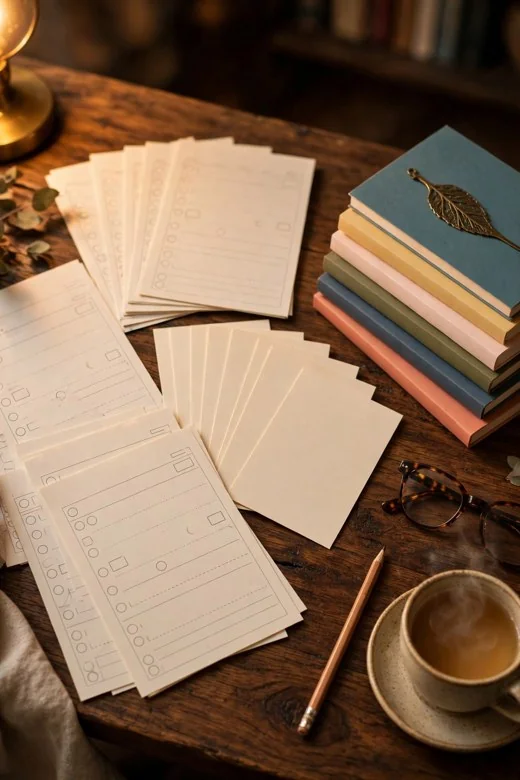 The Short-Story-Collection Book Club Kit
Run a book club for the book with ten beginnings and ten endings — story-by-story scorecards, per-story rating pages, favourites ballots in seven categories, a rank-the-stories finale, 24 theme-across-stories debate cards, and a ready-made discussion guide for Tales from the Clockwork Garden.
$6 launch price
View product In Translation — A Translated Fiction Companion
The only reading journal that logs a book's two authors: per-book spreads that bill the translator as an equal maker, translator trackers, The Phrase Kept with its author-and-translator double-credit rule, two-translation comparison pages, Lost & Found, a WIT Month planner and a Waiting List for the books that haven't crossed yet. No passages from any real book — apparatus only.
$7 launch price
View product