Reading Journals
Read It Again — The Reread Journal
The journal this edition points to: first-read memory snapshots, then-vs-now spreads, missed-clue logs — built for the second (and twentieth) reading of a book like the Carol. Free 3-page sample.
You already know this story. That is precisely why you should read it slowly. Charles Dickens's A Christmas Carol — the complete, unabridged 1843 novella, all five staves — read the slow way: with a companion written for this book and no other, standing at the end of every stave, asking you to notice what a lifetime of adaptations has trained you to skip.
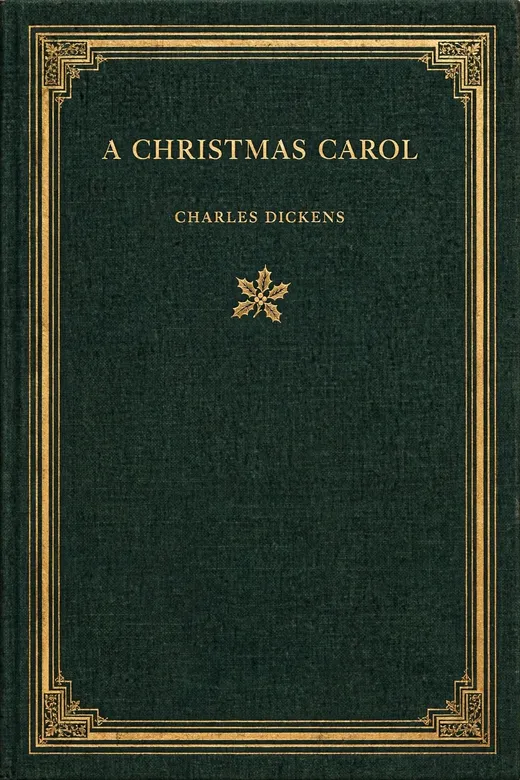
Inside the edition: Dickens's full text, exactly as published; a new Pagelyra introduction on why this small, dense, funny, furious book repays being read at speaking pace; a companion for every stave — a spoiler-light orientation, two reflection prompts written for that stave alone, a "slow down here" pointer to the passage that deserves your whole attention, and a one-line ledger for your own record; and, after the final stave, a character map, a themes essay on time, memory and the economics of a changed heart, a four-session reading-circle guide laid out for the four weeks of December, and a read-next page on making the reread a ritual.
No summaries instead of the book. No study-guide homework voice. Just the whole of Dickens's Christmas ghost story — the fog, the feast, the chain, the morning — and good company for the walk through it, one stave at a time.
The companion stands around the text, never inside it. The introduction waits at the front; each stave's companion is printed after that stave ends — orientation first, then the prompts, the slow-down pointer and the ledger line. Every orientation is written from its stave's opening only, so nothing ahead of you is ever given away. Only the closing materials, printed after the final stave and labelled as whole-book, speak of the ending.
Dickens's text is free to anyone — it has been in the public domain for years, and free bare-text copies exist. This page will not pretend otherwise. What the $8.99 pays for is Pagelyra's work: the editing, the original companion written for this book alone, the careful typesetting of a short, dense text with room for your notes, and the curation. Readers who only want the bare text are told, in the FAQ below, exactly where to get it free — which is the honest way to sell an edition of a public classic.
The read-next page of this edition says it plainly: a book you reread every December deserves a journal that keeps the Decembers apart. Read It Again — The Reread Journal seats each reading side by side, first-read memory on one page, the reread on the facing one, neither allowed to overwrite the other — so the book becomes a record of your own years as well as Scrooge's one night.
Yes, and we say so plainly: Dickens's 1843 text is in the public domain, and free bare-text copies exist (Project Gutenberg carries it). What you are paying for here is everything Pagelyra added: the original introduction, a companion written for every one of the five staves, the character map, themes essay and December reading-circle guide, and a carefully typeset edition with room for your own marginalia. If you only want the text, take it free with our blessing. If you want to read it slowly, in company, this December, that's this edition.
Completely. All five staves of the 1843 text, uncut and unmodernised — not Dickens's later shortened reading version, and not an adaptation. Our companion never interrupts it: the introduction stands at the front, each stave companion is printed after its stave ends, and the closing materials follow the final page.
There is little left to spoil — the Carol is the most retold story in English, and the companion cheerfully assumes you know the shape of it. What it protects is the route: each stave companion is written from that stave's opening only, telling you what to notice rather than how scenes end, and the reflection prompts are about the stave you have just read. Only the closing section (character map, themes essay, reading-circle guide), printed after the last stave, discusses the whole book, and it is labelled as doing so.
It was practically designed for you. The companion is written for the returning reader: it points at the sentences familiarity has worn smooth — the first page's legal fuss about a doornail, the exact words handed back to Scrooge in the later staves, the smallness of the goose — and the read-next page shows how to keep the annual reread in a journal, December beside December, so the book becomes a record of your own years as well as his one night. The reading-circle guide's four sessions are sized for the four weeks of December, for clubs that meet in the season.
Pagelyra sells honestly: paid checkout opens at launch, and the introduction and the Stave One companion are free right now as the sample. At launch the edition will be delivered as a digital ebook (EPUB + PDF) of 123 pages — the full novella plus the complete companion — readable on any e-reader, tablet or phone, with the PDF keeping the marginalia space for annotation.
Paid checkout is open. Pagelyra sells through Gumroad — pay securely on Gumroad and your files are ready to download straight after payment.
Buy now — instant downloadEvery product still has a free sample in the Free Library — try before you pay. Digital downloads are covered by our Refund Policy.
$8.99 at launch
EPUB + PDF · 123 pages · the complete 1843 novella + the original Pagelyra companion · Personal Use license (licensing details)
Of all the books in English, this is the one December keeps for itself.
A Christmas Carol has been in print without a pause since 1843, read aloud in kitchens, staged, filmed, parodied, and quoted at length by people who have never knowingly opened it. Nearly everyone knows its furniture: a miser in a counting-house; a business partner seven years dead; a clerk with a single shovelful of coal; three spirits promised before morning; a sickly child with a crutch; a hard man giddy on Christmas Day. Knowing the furniture, though, is exactly the danger. A book this famous gets read the way we cross our own hallways in the dark — quickly, by touch, seeing almost nothing. This edition exists to turn the lights on.
Its smallness invites the gallop. The Carol is under thirty thousand words — a single evening's reading, an hour or two — and most of us take the invitation and sprint. Dickens, it is true, sprinted first: he wrote the book in about six weeks in the autumn of 1843, in a state he described as half laughing and half crying over it, walking the London streets at night while the story took hold. It was published on the 19th of December and had sold out by Christmas Eve. But speed of composition is not a licence for speed of reading. This little book is packed the way its own plum pudding is packed: every paragraph stuffed, every sentence freighted. Almost nothing in it is only itself. The fog is never only fog. The cold is never only weather. And a sprinting reader, however warm-hearted, walks past most of the cargo.
It was written, besides, for the ear. Dickens spent years performing the Carol aloud — first for charity, then in the great reading tours of his later life — cutting a special version for the platform and delivering it to hushed halls for over two hours at a stretch. You can hear the platform in the prose. The sentences are built at speaking pace: long inventories that pile up like snowfall, short hammer-blow sentences that land like a clerk's stamp, questions flung directly at the listener. Read the descriptive passages aloud once — the fog, the counting-house, the feast piled in a bachelor's bare rooms — and the book changes temperature. Slowness is not a refinement for this book. It is the speed the instrument was tuned to.
Why read it slowly, then? Three reasons.
First, because of its form. Dickens did not divide the book into chapters; he divided it into staves, the verses of a song. A carol is not a lecture. It works the way songs work — by return and refrain. Words and phrases in this book are planted early, apparently in passing, and then sung back later in a different key, where they mean more and cost more. The careless phrase a man throws at a charity collector in the first stave will be handed back to him, itemised, before the night is out. You cannot hear a refrain at sprint pace. Slow reading is simply how you let the song do its work.
Second, because this is a book about time, written for people in a hurry — and December is the hurrying month. Scrooge's disease, underneath all the famous symptoms, is a ruined account with time itself. His past is written off as dead capital. His present is endured, not lived. His future is a creditor he refuses to meet. The cure the book prescribes is, literally, a re-examination of all three accounts — in one night, with interest. To hurry through such a book, glancing and skimming to be done by midnight, is to read it in Scrooge's own condition rather than in your own. The slower reader notices what the sprinter cannot: that the book is measuring us with the same rule it measures him.
Third, because its argument is made of echoes, and echoes take time to arrive. Dickens does not prosecute his miser with sermons — Marley's ghost attempts one speech and even that is mostly bookkeeping. Instead, the case is compiled: a ledger of scenes. How this man was made, what this man made of the world, what the world looks like without him in it — entry by entry, each shown, none summarised. The companions in this edition are built to mark those entries as they land: where a phrase returns, where an image is re-priced, where a door that was shut in Stave One is opened in Stave Five with the hinge oiled by everything between.
What to watch for, as you read:
The money language. The Carol talks about feelings in the only vocabulary its hero understands: price, weight, debt, wages, surplus, security, account. Watch how relentlessly Dickens keeps those books — and watch for the moment the vocabulary itself is audited, when the question stops being what is owed to Scrooge and becomes what Scrooge owes, and to whom, and in what currency the debt can actually be paid.
The weather. The book opens in fog and frost and a cold that seems to come from inside the counting-house as much as from the sky. The weather is not a backdrop; it has an arc of its own, and it keeps time with the man's. Notice what the sky is doing at the end of each stave. Dickens, the great stage-manager, is clearing his stage by degrees.
The food. For so short a book, the Carol is crammed with eating — thin gruel, a tavern dinner taken in melancholy, a goose whose smallness is a family's heroic arithmetic, a pudding flourished like a flag, piles of fruit and game and steaming drink, and one famous turkey. Track who eats, who serves, who carves, and who is described, in the book's coldest phrase, as surplus. Appetite is one of Dickens's moral instruments here: the size of a man's feast tells you nothing; the size of his welcome tells you everything.
The narrator. Dickens's storyteller is a person in the room with you — genial, gossipy, forever stepping forward to make sure you noticed, to swear to the facts, to address you as a friend whose intelligence he flatters and whose attention he occasionally scolds. Watch for the hinges where he hands the story directly to you. This book was made to be told, and its teller never leaves the fireside. In the companions that follow, we have tried to take his hint: company, not homework; a voice at the end of each stave, asking what you noticed.
One thing more to watch for — the children. They are everywhere in the book's machinery: a boy left alone at school through the holidays, a sister small and bright, children at a warehouse feast, six children around a tiny goose, two terrible children under a robe who are not children at all. Dickens believed, and built the belief into this book's foundations, that a society — and a man — is finally audited by its treatment of the young. Slow down when a child enters a scene. The book is doing its real accounting there.
A word about this edition. The novella is printed complete and unabridged, Dickens's 1843 text; everything of ours stands around it, never inside it. The introduction you are reading, the five stave companions, the character map, the closing essay and the December reading-circle guide are Pagelyra's own work, written for this book and no other. The companions give away nothing beyond each stave's famous opening situation; the closing materials, set after the final stave, are free to speak of the whole.
And a suggestion for the reading. The book is short enough for one evening and built to repay five. Read a stave a night across a December week, or a stave a week with the circle guide in Part Three, and let the thing accumulate the way its author let it accumulate in him — walking, thinking, half laughing and half crying. However you pace it, leave the last stave for a quiet hour. Some books end. This one, famously, keeps.
— The Pagelyra Editors
— End of the introduction. The Stave One companion below is also free, exactly as it appears in the edition. —
Every stave of the edition carries a companion in exactly this form. Here is the first, complete:
Orientation. Christmas Eve, a biting afternoon, in the counting-house of Scrooge and Marley — though Marley has been dead seven years, and his name has never come off the door. The stave opens by insisting on that death with comic thoroughness, then moves indoors: a fog so thick it pours in at the keyhole, a clerk warming himself at a candle because his master keeps the coal-box in his own room, and a sequence of visitors, each sent away — a cheerful nephew, two gentlemen collecting for the poor, one small carol-singer. Notice how completely Dickens builds Scrooge out of refusals before he allows anything in the world to refuse him.
1. ✎ The book spends its first page proving, like a solicitor, that Marley is dead — dead as a doornail, and the narrator pauses to argue with the phrase. Why does a ghost story need its ghost certified dead beyond argument before it can begin? What kind of certainty is Dickens really establishing? 2. In one afternoon Scrooge declines an invitation to dinner, a request for charity, and a song at his door. Name the three kinds of refusal — affection, obligation, delight. Which of the three is your own December most practised at, and what does the book suggest each one costs, in its own currency of time and warmth?
Slow down here. The homeward scene, and the front door of Scrooge's house — specifically the door-knocker, an object he has passed twice a day for years, which for one unaccountable instant is not quite itself. Dickens gives the moment almost no machinery: a familiar thing, wrong, and then right again, and a man telling himself it means nothing. Linger there. The whole night — and the whole book — turns on that hinge, and on Scrooge's decision to call it humbug.
Ledger. Christmas Eve at the counting-house: three refusals sent out into the fog, and a door-knocker that would not behave.
The printed edition leaves ruled space after the ledger for your own note on the stave.
The journal this edition points to: first-read memory snapshots, then-vs-now spreads, missed-clue logs — built for the second (and twentieth) reading of a book like the Carol. Free 3-page sample.
Our own original classic-in-the-making: Mira Solace, a garden losing minutes, and a gate that grew overnight. Chapter One free.
 The Bookish Gift Planner
Give every reader on your list the right book: match each person to one of ten reader types — 40 gift ideas — then set a budget that holds, list, track buying, making and wrapping, and write the note. A December gifting calendar, one task a day, 1–31 December.
$7 launch price
View product Starfall Academy — Issue #1
An original comic about four students at a school built inside a fallen star, and the light that wakes up hungry.
$5 launch price
View product The Perfumer of Glasshouse Row
Four linked scent-magic stories from Brindlewick: Hetty Crane bottles other people's moments — and every keeping costs her a memory of her own.
$4.99 launch price
View product